Small PBN Setup: 10-50 Domains, Hosts and HTML Links
A small PBN is 10 to 50 domains, not thousands. Registrars to hide in, why shared hosting beats a private IP, HTML instead of WordPress, and the link caps that avoid a penalty in 2026. The domain is still the hard part.
 DeepScan.pro

The launch is the easy half. The domain is the half that decides whether the link still counts in six months.
Alexander Chepukaitis spent about fifty minutes on the Ant-Team webinar on building this yourself. Not a thousand sites. A small PBN, in the band of 10 to 50 domains. Picking names he sent to older videos in the playlist. What follows is the part I still run, plus the figures that moved by October 2026. Where a number is his, I say so. Where it is a fresh crawl of public stats, the date sits on its own line.
A small PBN is 10 to 50 domains. A grid of thousands is a different machine. Do not scale his rules up, and do not shrink a mega-grid playbook down.
A 10-50 grid is another animal
At this size Google usually does not assemble the network on its own. A competitor rarely bothers either. Hunting a PBN costs more than the harm a thirty-site grid does to them. A complaint to Google pays off when the target is a large grid sitting in a hard top, not when someone owns twenty quiet donors.
That is not a reason to get sloppy. The minimum is still five things.
- Registrar, and the nameservers you actually delegate.
- IP and host.
- Fingerprints: WHOIS, analytics, Search Console, templates.
- The way the links go in.
- A wall in front of Ahrefs, Moz, Majestic and DataForSEO.
Google does not bother” is not the same as “this is inside the rules.” A site that exists to pass links is link spam. Small size is why it often stays unconnected. It is not a blessing.
Expired-domain abuse has been a named spam policy since March 2024. Google’s own examples are the ugly jumps: affiliate content on an old government domain, casino content on a former school. A white topic that lived, then moved one step toward a neighbor, is a different shape. It is still your job not to look like the examples.
What to buy, and what to skip
He was blunt in the questions. There is no secret domain list. You read a lot by hand.
A strong domain brings traffic. A link from that domain does too. Domains bought to be glued onto a main site, by redirect or canonical, work well for him. Newly registered names can rank as your own project. As a donor they are weak. I do not pay donor money for a fresh registration.
Filters I will not drop:
- History stays clean. No stretch in porn, gambling and the same family.
- White topic to another white topic is fine if the old one lived more than a year.
- Links should be alive. Anchors should not be a pasted sentence repeated 400 times.
- For 30 to 50 domains, a perfect topical match is optional. He treats the chase for an ideal niche as a waste.
- Metrics are worth a look and a discount. Dead links and a spam anchor file make a pretty DR (domain rating, a third-party strength score) lie. That caveat is from his older sessions, and it has not aged out.
Index, and the absence of a filter, show up only after you own the name and put pages on it. Sometimes old URLs are still indexed on the day you buy. Not often. Do not pay as if that were the default.
His reading of Google’s patents: the system keeps up to about twenty past topics for a domain. I have never seen Google confirm the number. I still shift the topic like a staircase, not a jump.
Cars, then auto parts, then parts for a refinery, then oil refining. That is his ladder. Mine last spring was duller and worked the same way. A regional cooking blog that had published for three years became home canning, then small-kitchen gear. Two rewrites, five weeks, no leap into a casino or a loan vertical. Then one link, to one cookware URL, from the homepage.
If the archive shows a real business, do not put that business back. Rebuild nothing “as it was before the drop.” Their team already took a lawsuit and more than 100,000 RUB in lawyers on generative pages, with nobody else’s license in the files. The pressure was over images and similar claims. The write-up sat in their Telegram about a month before the webinar. Fight pages with new generative copy. It is almost free, and it does not wear the old company’s face.
On competitive markets the public drop is the leftovers. Normal names leave at auction, or a backorder catches them at the moment they fall. Look at the free drop if you want. Little there is worth a donor slot.
On anything longer than a coffee-break list, the small PBN shortlist goes through one pass: archive by year, anchors, live links split from leftovers, and a written score. About forty seconds a name instead of three minutes of tabs. Ahrefs, Moz, Majestic and DataForSEO stay in the stack as the crawlers I block later, not as five extra windows per domain.
Hide in the registrar crowd
People mix up two piles and then hide in the wrong one.
The registrar is who sold you the name. The nameserver is where the name points. You can register in the biggest crowd and still stick out, because you delegated to a host almost nobody uses.
What matters is delegated NS. Written, and pointing somewhere. A registered name with no delegation is not cover.
On the webinar, for .ru, he read the crowd like this.
| Registrar | .ru domains, his figure |
|---|---|
| Reg.ru | about 3 million |
| Ru-Center | about 1 million |
| Beget | about 0.5 million |
| domains.ru / Expired, his 7th place | where he sees most drop buys |
Of those ~3 million at Reg.ru, only about 349,000 had their own host NS set. A bit over 10%. After that the piles get thin fast.
He splits a grid of about thirty across the fattest NS groups. Part Reg.ru, part Timeweb. Same method on any other country: pull that zone’s stats, do not reuse Russian host brands because a slide said so. He will move a name to a safer trace even when the move costs more.
Prices he quoted that day: Nic.ru around 1,000 RUB and up per name. Reg.ru is expensive at the retail counter. Through a partner, renewal could be talked down to about 200 RUB and up, which is ordinary .ru renewal money, not a trick price.
Public sticker I checked while writing this, 18 October 2026: Beget listed .ru registration from about $2.38 and renewal about $5.01. Cheap is fine. Thin is not. Do not park thirty domains at a registrar whose NS pile you can count by hand.
The NS map moved after the webinar. This is not a registrar table. It is who the domains point at.
StatOnline, DNS providers in the .ru zone, valid 17 October 2026:
| NS provider | .ru domains | Share |
|---|---|---|
| reg.ru | 1,497,765 | 24.07% |
| beget.com | 560,835 | 9.01% |
| beget.pro | 548,398 | 8.81% |
| ns.cloudflare.com | 476,199 | 7.65% |
| beget.ru | 444,160 | 7.14% |
| hosting.reg.ru | 362,545 | 5.83% |
| timeweb.ru | 347,752 | 5.59% |
| timeweb.org | 330,424 | 5.31% |
| nic.ru | 279,707 | 4.49% |
| domains.ru | 224,679 | 3.61% |
Beget’s three NS brands together: 1,553,393 domains.
Timeweb’s two: 678,176.
reg.ru plus hosting.reg.ru: 1,860,310.
hosting.reg.ru alone, the “own NS” slice he was pointing at: 362,545. The 349,000 figure barely moved.
For scale, StatDom on 20 March 2026 counted 6,095,839 .ru names, 5,879,486 of them delegated, 96.45%. March and October are not one snapshot. Use them as the size of the crowd, not as a live inventory.
Hiding “only at Reg.ru” is the outdated version of his own rule. In October 2026 the crowd is at least two crowds. I split a thirty-name .ru grid across Reg.ru, Beget and Timeweb NS, a few accounts each, never one login.
Cloudflare’s NS pile is real, 476,199 names, 7.65%. It is the wrong crowd for a visitor in Russia. More on that under hosting.

.ru after 1 September 2026
On the webinar someone asked about Gosuslugi checks for .ru from September. His hunch: the zone gets whiter, prices might ease. He immediately said it would not be exactly like that, and he did not expand.
Here is the part that is no longer a hunch.
Federal Law No. 569-FZ of 29 December 2025 requires the admin of a .ru, .рф or .su name to be identified through Gosuslugi (ESIA, the state login). The account has to be verified. A half-finished profile does not count.
From 1 September 2026, once your registrar is actually enforcing it, you cannot register, renew, change NS, change the admin or transfer without that check. The name is not deleted on the morning of 1 September. It dies later, at the end of the paid period, if nobody who can pass the check renews it.
RU-Center’s own note is the piece people skip. Until a registrar is placed on the government list, it keeps working under the old rules. The outside date they cite is 18 January 2027. So on 18 October 2026 this is not one switch that flipped every .ru name. It is a cliff that arrives registrar by registrar.
A foreign admin with no verified Gosuslugi account does not have a clever WHOIS trick left. When that registrar flips, the name cannot be renewed or repointed. Budget the grid by who can legally pass the check, not by the renewal price.
What I expect in the drop lists through winter: more names from people who could not verify, and the same shortage of good ones. Clean domains still go at auction or to drop-catch. The extra corpses do not become extra donors.
Shared hosting, on purpose
For a small grid he uses shared hosting, not a VPS (a virtual private server, a machine that is yours alone).
On one shared IP there are dozens, hundreds, sometimes thousands of sites. A porn neighbor on a normal white host such as Beget is unlikely. They pull prohibited sites off.
How many of those sites may be yours:
- About three of yours on an IP is the feel of his talk.
- Ten of yours among about a hundred strangers is already acceptable.
- Ten of yours alone on a dedicated IP is a bad diagram. That IP has one owner.
I keep a written cap of three of mine per IP. In February I put three .ru donors on a Beget address that already carried a dental clinic and a one-man shop selling polycarbonate sheets. Boring neighbors are the point. The moment an IP is “my IP,” I have built the footprint the host was supposed to bury.
SEO hosting, the product where each of your sites gets its own IP and that IP still holds 100 to 200 strangers, breaks the tie between your sites harder. It also costs a lot more than shared. He barely remembers the offer in the Russian market and has hardly used it. I have not found a reason to be the first.
A separate VPS is for foreign sites, and only where Cloudflare still works. Ten to fifteen sites on the VPS, Cloudflare in front, the real IP hidden. Different Cloudflare accounts, so the NS pairs actually differ. One account often hands out different NS if you add sites weeks apart. They do not rely on that, and neither do I.
Cloudflare in Runet, October 2026: Russian ISPs throttle it to about 16 KB per connection. Cloudflare has said it cannot fix this from its side. A page behind Cloudflare does not really load for a visitor in Russia. His line from the webinar, “CF is not available for Runet,” still holds. The mechanism is a throttle, not a clean off-switch. Use it for a foreign audience. Do not use it for a site a person in Russia must open.
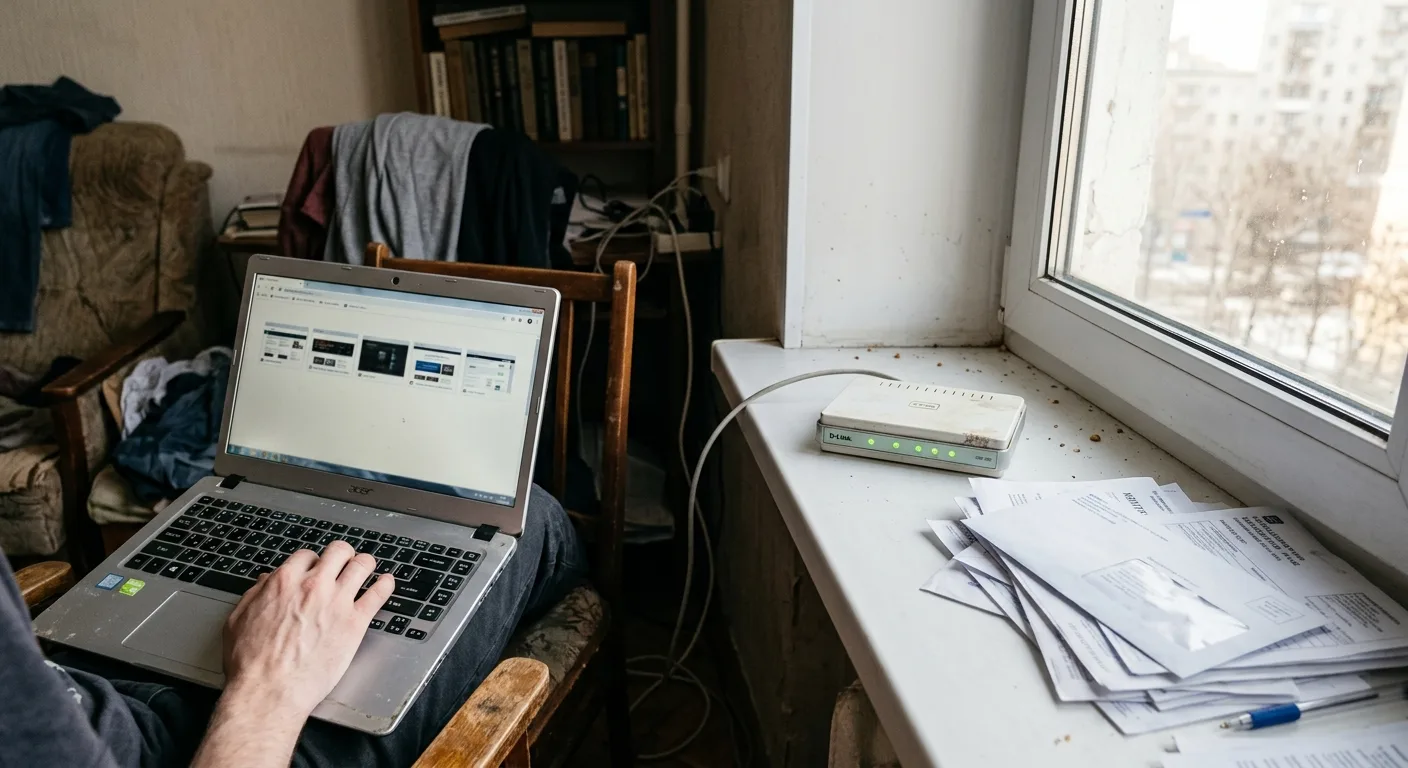
Putting one up on Beget
His click-path, still the one I use when a name has to be on that host:
- Domains and subdomains.
- Add the domain.
- Create a new site.
- If you insist on a CMS (content management system, the software that builds pages for you): WordPress, then install.
- Copy the host NS from Beget’s left panel.
- Paste those NS at the registrar. His example was Expired.
- Then the template.
Three to five sites on one hosting account. Not thirty. A new account is cheaper than a shared login that ties the whole grid to one password reset and one billing email.
Footprints that still burn you
One analytics property for the grid is a no. One Search Console for the grid is a no. He does add Search Console, a separate account on every site, and pulls the numbers back through an API key. The accounts are separate. The spreadsheet does not have to be.
WHOIS, public registration data, stays “private person.” Registering on a company lights up the fields. After the Gosuslugi change, the sharper trace is not the public WHOIS line. It is the verified human on the registrar account. Split accounts the way you split NS.
Also:
- Different templates. If you still touch WordPress, take popular themes from the catalog, several of them, picked by install count. A popular theme blends in. A rare theme is a fingerprint with a homepage.
- Sites in the grid never link each other.
- Do not open the index for all of them on one morning. I release two or three a week. Thirty on a Monday is how a crawl log starts to look like a person.
SEO bots get cut off in robots.txt or in .htaccess, so the grid is harder to map from a link index. He said he would post the bot list on GitHub the next day. That link was not in the video description afterward.
robots.txt is a request. A polite bot obeys it. A sloppy one does not. A deny by user-agent in .htaccess or nginx is stricter, and a bot can still rename itself. You are raising the price of finding you, not becoming invisible. Googlebot stays allowed. Blocking Google to “be safe” just means you have no donor.
The ones I deny, because they are the indexes people actually buy:
- AhrefsBot
- MJ12bot
- DotBot
- DataForSeoBot
- SemrushBot
Add the rest when you meet them in the logs. Do not copy a 200-line list from a forum and forget you also blocked a render you needed.
Static HTML beats WordPress
On small volume he used to build WordPress by hand. He now calls WordPress extra weight for a PBN.
A model can edit static HTML without leaving broken shortcodes. The site is fast, hard to knock over, and easier to index because it answers quickly. WordPress eats the shared plan and pushes you onto a pricier tariff, which pushes you toward fewer, louder accounts. That is the opposite of hiding.
A new prompt gives a new layout. One prompt, five or six pages, a few minutes. His demo on the webinar was a spammy drop that had passed the automatic check and failed the manual one, due to drop again. The early archive snapshots were dry historical notes. The model turned them into a small gear shop, four or five pages, generated text, about one second to load.
He was clear about the limit. For a site you mean to keep, the text has to be longer and stronger, or the index is not a promise.
I do not ship a donor as a four-page shop anymore. The September 2026 spam update ran from 24 September to 8 October, about fourteen days, the longest spam rollout of the year. Google named no new policy. The early public pattern was templated, programmatic pages. A fresh prompt per site is not a design hobby. It is how fifteen HTML sites avoid looking like one template with the title swapped.
Speed still helps a thin site get crawled. It does not keep a thin site in the index. His gear-shop demo is a build demo. It is not the page I would put a link on.
Write the page that will carry the link as the long one. Supporting URLs can be shorter. If you only have budget for one good text, that is the page.
Links, after the site has sat
Order is the whole tactic.
Let the site sit. Get the first index. Move the topic one step toward the target. Only then place the link.
I waited 41 days on one donor this year, until Search Console showed impressions on the homepage. Not clicks. Impressions. Then one link. The page fell out of the index in week nine. I rewrote that URL and the two next to it. It was back in eleven days. I did not rebuild the domain. Their team runs the same idea as a weekly machine: watch the indexed URL that holds the link, update it and the neighbors if it drops, never a full reconstruction. Full rebuilds cost more than the link is worth. The client promise he described is a year of work, plus however long it keeps living after that.
What not to place:
- No footer links.
- No sitewide links. He reads the patents as allowing a penalty for that, and a sitewide does not pass what it passed years ago. A link from the homepage gives more.
- No links between your own grid sites.
- Not dozens of outbound links on the domain.
- Not ten outbound links on one page.
One outbound link on a page. More of the page’s weight goes with it. About ten outbound links on the whole domain, and only if the donor’s own inbound count can carry that. Better if those few links hit one or two URLs you care about, not twenty of your projects.
Anchors, the visible text of the link:
- 100 to 500 identical anchors is a high chance of a penalty.
- One to three identical anchors in a month is the pace he calls normal.
I keep a month sheet. If an anchor already went out twice in October, it does not go out a third time until November, and not from a site that shares the host account.
A homepage link to one URL, with an anchor you have barely used, after the page is indexed. That is the whole “safe” pattern. Everything fancier in this section is how people talk themselves into a footer.
Index without traffic
Take the domain. Index on its own is a good signal. A link PBN usually has no traffic. You can squeeze a little with easy queries if you want. You do not need it.
He ignores positions from outside rank trackers. He watches impressions and positions in Search Console. Impressions in GSC mean the domain is strong. No impressions, and it is only a candidate for a link if you can get the URL indexed and keep it there.
Two different jobs, two different tests:
- Link donor: the page with the link is indexed, and it stays indexed. Traffic is welcome and not required.
- Gambling money site: quality is impressions in GSC. Impressions showed up, the domain landed, and it can take more work if the brand allows it. No impressions: do not feed it as a money site. Use it as a donor, or keep pushing indexation.
For iGaming he wants donors from everywhere, including topics that are not yours. Even large “white” gambling sites, in his experience, live about 1 to 1.5 years before Google cuts them. The plan there is to take the traffic and the money while the site is alive. Your own grid, if it points at gambling, should still be walked toward games and the neighborhood. Other people’s donors can come from anywhere.
Second-level links, the cheap mass people want to pour onto the PBN itself: not on a white project. Hard to buy, hard to justify. They buy domains that already have links and they keep those links. If a strong old link hits a URL that is not the homepage, they build that URL up under it instead of dragging the link home. For betting and gambling it is the reverse. Life is short, so mixed link mass goes in early. What the questioner called “second level” he files as low-quality links. Do not pour them on a normal domain. On a gambling domain, for a fast result, you can.
New registrations, one more time, because it gets asked twice every session: fine as your own site, poor as a donor.
If 95% of the grid indexes and the queries sag two months later, the domain is hungry. Update what is there and add something new. Without that, the drop is steeper. I treat three or four quiet weeks in GSC as the cue, not the quarter-end report.
Brand anchors and AI Overviews
He says triplets work right now, and only if the site is already in positions. A triplet is a tight three-part answer. That block gets into the AI Overview and takes a slot from a competitor. He says he has watched it on his own pages. I believe the condition more than the magic. A triplet on a URL that does not rank does nothing.
Since 15 May 2026 Google’s spam policy also covers generative answers in Search, including AI Overviews and AI Mode. Earning a quote because you already rank is not the same trick as a web of fake mentions built to bait the overview. The second one is what that wording is for. I do not build it.
Public write-ups of the 2026 spam updates, including the long September run, did not describe them as link-spam updates. Separate from that, industry notes on the August wave did list weak grids: same server trace, sites linking each other, unnatural anchors. Both can be true. Google did not publish a “we found PBNs” post. The footprints above are still how a thirty-site grid gets connected by a person, or by a model, without any new law.

Show Google one page, everyone else another
He was asked how to close a domain to everyone except Google. His answer was canonical cloaking: the canonical of one zone is glued onto another zone, and the content itself gives a rater nothing obvious to grab. He is not planning a separate video.
The question he types into a model is plain. How do I give one version to the search engine and another to everyone else. If the model refuses, he rephrases. He did not publish a config.
What this is, in one line: users get one page, and the canonical tries to make Google treat a different zone as the main copy.
Google’s cloaking rule is serving the crawler a different thing than the visitor, in order to move rank. A small site can sit like this for a while. It can also become a manual action the day someone opens both versions and sends the screenshots. If your user-facing HTML and the canonical target disagree, you have made that screenshot easy. I am not going to pretend the webinar’s answer is a protected setup. It is a bet.
Foreign PBNs he left alone. One sentence: a separate circuit, and an interesting one. The only piece I will add is the one already above. Cloudflare in front of a VPS still hides the origin IP for a non-Russian audience. It does not hide a .ru site from a Russian ISP in 2026.
If you remember one page
- 10 to 50 domains. Not a thousand.
- Buy clean history. Walk the topic. Do not restore the old company.
- Hide in fat NS piles. In .ru that is Reg.ru, Beget and Timeweb, split up. Check the date on the stats before you copy a table.
- Shared IP, about three of yours in a crowd of strangers. Your own IP is the loud option.
- One host account, three to five sites. One Search Console per site. No links inside the grid.
- Static HTML, a new layout every time, a long page where the link will sit.
- Index first, nudge the topic, then one link from the homepage.
- One to three identical anchors a month. Not a hundred.
- Feed the URL when impressions stall. Do not rebuild the domain.
- For .ru, know which human can pass Gosuslugi before you renew past your registrar’s cutoff.
FAQ
How many domains is a small PBN? 10 to 50. Above that you are building the other kind of grid, and these rules stop fitting.
Does Google automatically find a 10-50 domain network? Usually not. The risk is footprints you align yourself: one IP, one analytics login, one template, links between the sites, a burst of identical anchors.
Shared hosting or a VPS? Shared for a small grid. A VPS only for foreign sites, 10 to 15 of them, with Cloudflare in front and the real IP hidden. Cloudflare is the wrong front door for visitors in Russia in 2026.
Is WordPress worth it on a small PBN? Not for him, not for me, not in 2026. Static HTML is faster, cheaper on the shared plan, and a new prompt is a new layout. The text on the link page still has to be long.
How many identical anchors in a month? One to three. A batch of 100 to 500 identical anchors is how a small grid earns a penalty it did not need.
Should the link sit in the footer? No. No footer, no sitewide. One link from the homepage, after the page is indexed, beats a link on every URL.
What changed for .ru on 1 September 2026? Admins need a verified Gosuslugi account under law 569-FZ, for .ru, .рф and .su. The name is not deleted that day. Renewal and NS edits fail once that registrar enforces it. RU-Center has said old rules can hold until the registrar is listed, or until 18 January 2027.
A domain is indexed and has no traffic. Do you still buy it? Yes, as a link donor. The test is whether the page with the link stays in the index. Traffic is optional. Impressions in Search Console are the signal he trusts. Outside rank trackers are not.
Comments
Sign in to leave a comment
No comments yet — be the first.