Buy Expired Domain Names Safely: A Step-by-Step Guide
A name with old links is not a clean name. Where to buy it, what to check, how the drop clock works, and what to do after the win so a penalty does not come with the invoice.
 DeepScan.pro
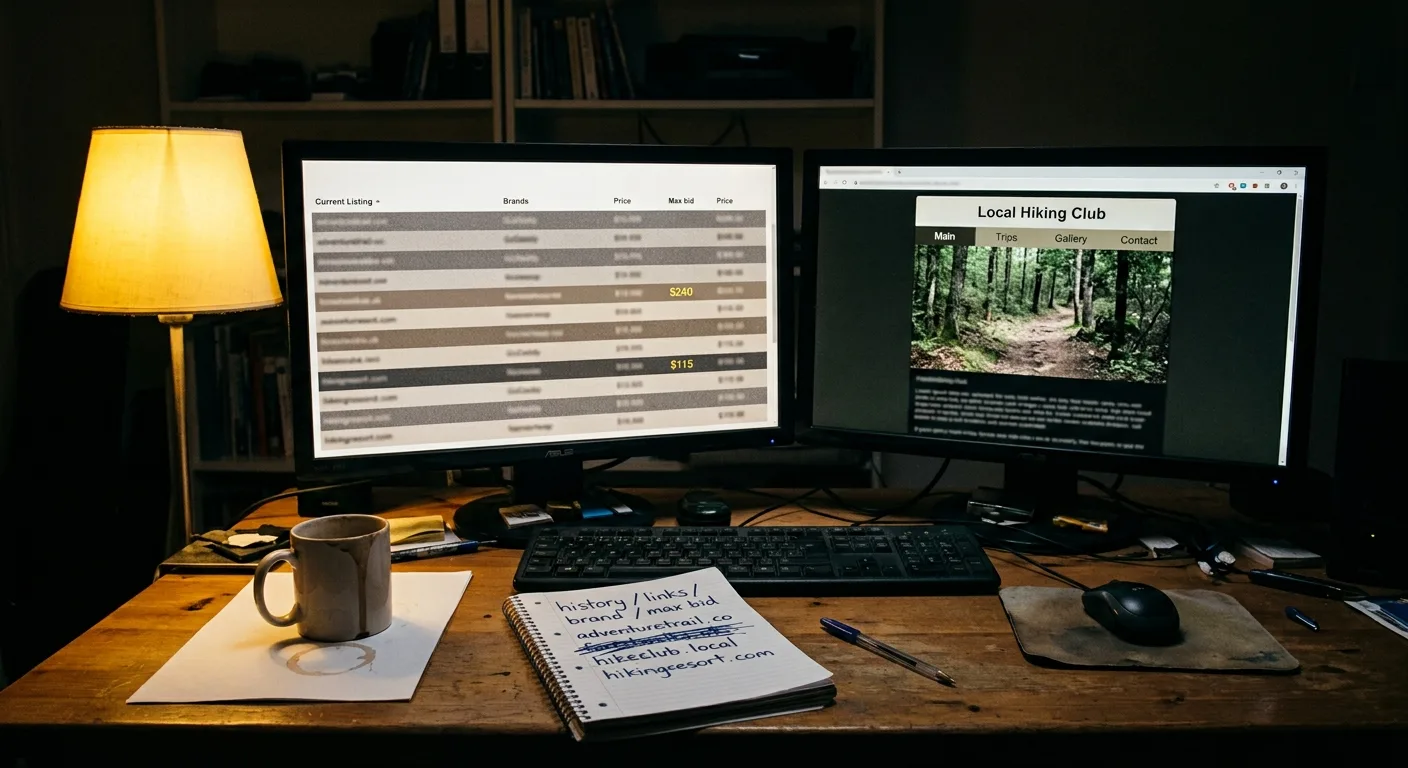
A name the last owner stopped paying for is not a gift. People take one because the links are already there, the name is old, or strangers still type it. None of that is worth cash if the past is dirty. I buy expired domain name deals only when those links match a site I will actually publish. Cute strings do not get a bid. Four moves, same every time: see where it sits, read the years, write a max price, and only then send the money.
You do not need a comprehensive guide to theory. You need a kill-rule you will actually follow at midnight.
A winning bid is not your name yet. On many of these sales the old owner can still renew, and the lot dies. Do not build, announce, or point DNS until the name is in your account.
Where the names are sold
There is no single shelf. The type of lot changes the price, the clock, and whether the registration date survives.
GoDaddy, Dynadot, closeouts
GoDaddy expired auctions are the wide end of the market. In a May 2026 post GoDaddy said it adds over 50,000 of these names a day. Membership is about $5 a year. The clock uses a soft close, so a bid in the last moments adds time. Sniping does not end the fight. It starts an extension.
Names that nobody bids on fall into closeout. The price steps down, sometimes to around $5. That is where quiet buys hide, and where dirty names hide in the same bin. Dynadot is the smaller door: about $5 in the account lets you bid, and unsold names walk a ladder near $30, then $15, then $5. Namecheap has its own closeouts and listings if the rest of your portfolio already lives there. One login is not a reason to skip the history check.
GoDaddy retired its backorder product on 7 October 2025. For a true public drop, that queue is gone. Read the current bid rules before you fund the account. They were updated again in early 2026.
Winning before the name deletes usually keeps the original registration date, because the name never left the registry. It moved. A fresh catch does the opposite: creation date becomes today, while the archive can still show 2009. That gap is why the sale, not the drop, is the route when WHOIS age matters to you.
Deleted domains and the drop
A dropped domain has finished pending delete and gone back to the registry. DropCatch, NameJet and SnapNames try to register it in that second. DropCatch is about $59 to $60 if you are the only buyer, then a public auction if several people wanted it. NameJet and SnapNames sit nearer $69 to $79, and a contested name goes to a private auction. Those two have shared inventory since 2020. Backordering both is not two chances.
Place the backorder before pending delete. Once it drops, you are racing scripts, not people.
DomCop tracked about 500,000 dropped names from 7 September to 6 October 2026. Strong names, DA 20+ and Trust Flow 10+ together, were 66% gone within a day and 83% gone within four weeks. Across the much wider set, DA 10+ or TF 10+, only about 19% were taken on day one.
A strong name still has about a one-in-three chance of being free the morning after the drop. Backorder the few you cannot lose. Hunt the average ones the next day, at registration price, after the catchers have taken what they wanted.
A lot of expired domains with mediocre numbers are still open a day later. The crowd only sprints at the obvious rows.
Expired domains for sale
Sedo, Afternic and Flippa are a domain marketplace. Someone already caught the name and listed it. You pay more than a closeout, and you can talk. This is where aged domains for sale usually sit, including premium domains a brand might want for the word alone. Do not use link math on a one-word .com. That buyer is not you.
On a stale listing I offer what I would have paid to catch it, not what the seller typed. One offer. If they have been sitting for a year, 40% to 60% of the ask is a normal place to start. If the "site" on Flippa is a thin template glued to a tired name, I close it. You would be buying a story, not a business.
The list, not the shop
ExpiredDomains.net is the free tool. It is a domain list, not a seller: drops, closeouts and live sales across a lot of TLDs. Register, or the useful filters stay hidden. Then filter domains by age, referring sites and the words you care about, and go bid somewhere else. Treat that list of domains as leads. It is not a cart.
Public expired domain lists have a crowd problem. Every bargain on them is on someone else's screen the same morning. A pretty row is not a secret.
Paid aggregators such as DomCop are for volume, when you search for expired domains every week and you are tired of twenty tabs. They still do not vet the name for you.
What happens after names expire
A domain name does not vanish the day names expire. The site and the mail can die fast. The name stays locked.
For a typical .com the path is:
- Grace. The domain registrar can still renew it. This is when most auctions run. Often up to 30–45 days, and that length is the company's own rule, not a law of physics.
- Redemption. About 30 days. Only the old owner can restore it. The fee is commonly $80 to $150 plus a year of renewal. You cannot buy it from a stranger in this window.
- Pending delete. About 5 days. Nobody can renew it.
- The drop. The registry releases it. Catchers are already waiting.
Many .com names take on the order of 75 to 80 days from the day they expire to the public drop. That is not the day you can bid. The sale happens earlier, while the owner may still renew. Country-code names ignore this calendar. Check the TLD before you backorder anything.
Once the domain expires, treat the WHOIS date as a deadline for the owner, not as the day you can register it.
Auction first, backorder second. A name that sells while it can still be renewed never reaches the drop. Backordering that name is a fee you did not need to think about.
Names expire, get listed, fail to sell, and only then crawl toward deletion. If you are buying for a build, the listing and the closeout are the sane windows. The drop is for one name you already decided you want. A failed card will often renew after the name does expire. A closed business usually will not. That is the difference between a name that comes back and a name you can actually take.
Check the name before you pay
No house vets the lot for you. In 2026 GoDaddy shows extra signals inside the listing, including data from EstiBot and Semrush. Useful as a first screen. Not a decision. The same checks apply whether you buy a domain at closeout or you are purchasing an expired domain from a marketplace.
I kill a name on the first failed test. I do not average a bad archive against a pretty metric.
Domain history
Open the Wayback Machine once, then stop trusting the last thumbnail. Walk the years.
Keep it if the topic stayed put and the pages look like a person made them. A club, a local service, a small tool, a retired magazine. Boring is good.
Drop it if the topic jumps into casino, pills, loans or adult, even for a few months. A clean decade does not rinse one doorway year. Drop it if the only pages are "this domain is for sale" or a chain of hops into some other site. Drop it if the language of the site flips and the old business vanishes.
Domain age on a fresh WHOIS line lies. Catch a deleted name and the creation date becomes today, while the archive still shows 2009. Trust the archive. The new date only tells you that this owner is new.
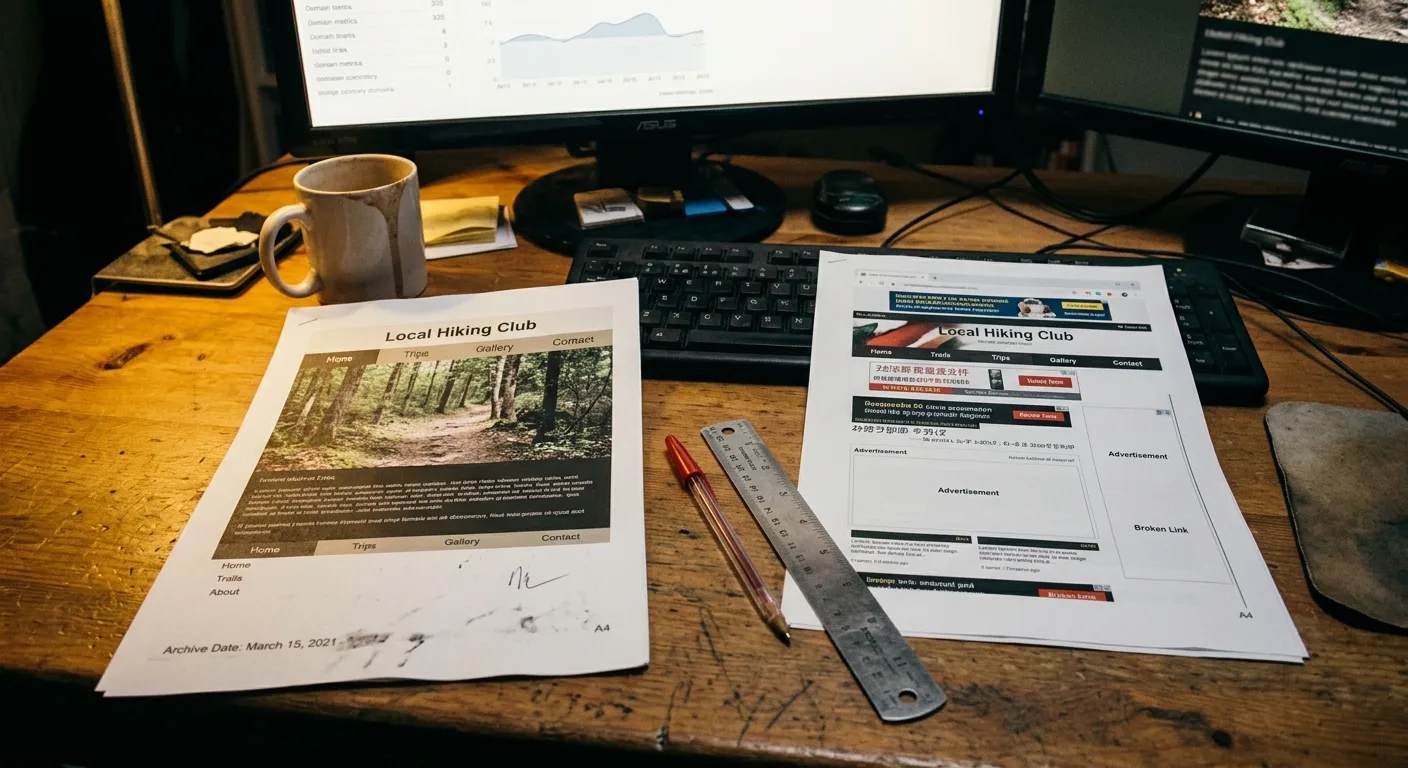
The one I still use as a mental picture: a dental name, solid pages from 2011 into 2022, then a year of foreign casino templates right before it went quiet. The early years were bait. I left it. The name I took instead was a small hiking club, same topic the whole way, links from town papers. I put the old trail URLs back and wrote them properly. Within a quarter it was visible again for those local hike queries. Same playbook, opposite archive. That is the split that matters.
Links, not a vanity score
Read the backlink profile before you read the chart. The number of backlinks is the easy lie. Five hundred links from six sites is a farm. Fifty links from fifty real sites is a site.
Then read the anchors. If they are loans, pills, or a casino brand, the profile is spent. Existing backlinks only help if you would be willing to show the list to a client.
Domain authority shows up on every grid, and it is still a third-party score. So are DR and Trust Flow. Search engines do not look up your DA. I still glance, because the gap is informative: a high score, almost no real visits, no brand anchors, usually means the links were built.
A cut I still use from Majestic: Trust Flow divided by Citation Flow. Under 0.3 I assume junk until the links prove otherwise. Over 0.5, and topically matched, I keep going. Weight Trust Flow over DA when you decide what to backorder. The fast buyers already do.
A manual action stays on the domain after the sale. You cannot see it beforehand. It appears in Search Console only after you verify. Point a penalised name at a site you care about, and you can import the problem. There is no public button that reveals this before you pay.
An expired domain with traffic
The traffic filter is the one everyone turns on, and the easiest screenshot to fake. Ask what the visits actually were.
Existing traffic that is just the old brand typed into Google dies with the old business. Organic traffic is interesting only when the queries match the site you will run. Search traffic that was one news post from 2019 will not come home.
That premium is real only if a tool you trust shows the pages and the queries, and those queries still exist this year. No recent analytics view, no traffic premium. Price the links, not the legend.
Buy expired domains with traffic when you will keep that topic. If you will not, you are paying for a number.
The keyword, the brand, the index
Say the domain name out loud. If it is someone else's brand, or a typo of one, search the trademark before you bid. A dispute costs more than the lot. Similar domains that stick a hyphen on a famous name are not clever. If the company is still operating and simply forgot to renew, leave it. You do not want their lawyer, and you do not want their customers' mail.
Look at the keyword the old site actually lived on. If you will not publish that topic, you are about to throw away the only reason to pay.
Then search site:thatname. Years of history and zero indexed URLs is a smell: a manual action, a hack, or a site that was never real. None of those are a discount.
Write the kill-rule before you open the bid box. Mine is topic change, a drugs or casino year, a trademark, or more junk anchors than real sites. One strike, tab closed. A nice score at midnight is how budgets die.
Stack the checks when the list is long
Doing this by hand is fine for five names. It gets sloppy at five hundred. For a weekly list I run an expired domain research tool that puts the archive, the donors and a written verdict on one row: DeepScan. About 40 seconds per name instead of three minutes of tabs, a 1–10 score from 13 checks, spam signals across 14 categories, pay per name rather than another monthly seat. Ahrefs or Majestic still stays open for the shortlist I am about to bid. The tool throws out the obvious junk. It does not outvote a topic change I can see.
How to check expired domain before buying, in one line: archive years, real referring sites, anchors, trademark, index. In that order. An expired domain tool that skips the archive is a toy.
How an expired domain auction actually goes
Set the ceiling from the links and the topic before you see the other bids. If two months of ordinary outreach would rebuild those links cheaper, stop, unless the topical match is ridiculous.
Do not bid on day one. An early bid tells the room the name is alive. Come back when the clock is short. Because of the soft close, type your max once the extension starts, and leave. "Ten more" is how a $40 name becomes $400.
Closeout is the other sport. Nobody negotiates. The first person to take the current rung gets the domain. Check the history on the day the price enters your range. Do not fall in love while it is still $50 and feel clever when it hits $8. Clever is the archive, not the discount.
Renewal sits on top of the hammer price at most houses. A $12 win is $12 plus a year. Write the year into the max.
The number of expired domains you can open in a night is much higher than the number you should buy. I bid about one in thirty. The rest fail the history test, and that is the work.
Signals on the lot page are only a first sort. EstiBot-style data can tell you the string is registered in other extensions. It cannot tell you the site spent 2023 as a doorway. Sort with the signal. Pay only after the archive.
Acquiring an expired domain
Pay inside the invoice window. On GoDaddy that is often about 48 hours. Miss it and the win can die. Read the lot. Rules are not the same on every platform.
If the old owner renews, a normal house refunds the bid. You still lost the research time. That is the tax. Do not stack three days of design on a name that is not delivered.
Then, in this order:
- Renew the domain for more than a year if you intend to build. A name that falls again in eleven months is a present to the same catchers.
- Transfer it to the registrar you already use if you do not want it left at the house that sold it. Auth code first, then lock. Locking first is how people trap their own name.
- Add it in Search Console the same day. Open the manual actions report before you sketch a homepage.
- Decide the use before you touch the link graph.
There are three uses that people actually mean. Only one of them is calm.
Rebuild. The default, and the one search engines are built to tolerate. Same topic, real pages, the old URLs brought back where the links point. You continue a site. You do not rent its past. Restore the linked URLs first, not a pretty homepage that leaves every old link on a 404. This is the clean way to use domains for SEO.
A single mapped hop. One hop can still carry relevance when the topics match and the links are real. Send each old URL to the closest new page. Do not dump the whole name on the homepage. In March 2024 Google wrote the line that killed the lazy version: expired domain abuse is where an expired domain name is purchased and repurposed mainly to manipulate rankings with content that has little or no value to users. An off-topic hop sits inside that sentence. Their systems can also just ignore it. A penalty or a zero. Both are a bad trade. One redirect, from the old URL to the closest matching page. No redirect at all if the topics do not match. A third redirect, chained through some other name, is how a simple hop becomes a footprint.
A private blog network. Some operators still wire older domains together to prop up one money site. It is the use with the shortest life. Several sites on one host, one template and one analytics ID are not a puzzle anymore. If someone does it anyway, each site has to stay about its old topic, on separate infrastructure, with no sitewide footer. Quiet devaluation is more common now than a speech in Search Console. I do not put a client's budget on that structure.
What I will not do: revive a hacked doorway, point a penalised name at a money site, or buy a pile of names in one niche on one afternoon and tie them together. That is one footprint with several invoices.
A disavow file is a scalpel. If you bought the links, do not disavow the links. Upload one only for an obvious blast of junk pages, and only after the property is verified. Disavowing "to be safe" deletes the thing you paid for.
What I run before I get the domain
Six lines, written, not remembered:
- The archive topic is stable. No casino, pills, adult, or hacked year.
- Referring sites are real, and the anchors match the topic.
- The score and the visits tell the same story. Backlinks and domain authority do not get to disagree by a mile.
- The string is not a trademark and not a typo of one.
- site: shows an index, or I can explain the gap.
- The max bid is on paper, renewal included.
If I cannot tick them, I pass. There will be another tomorrow. There is no shortage of available domains. There is a shortage of clean ones. Domains available at $5 are not a sale. They are a queue.
Which names look valuable and are not
High-quality domains are rarely the cheapest row in a closeout. Quality expired domains usually have a dull past: the club, the local shop, the small archive of a tool somebody cared about. Valuable expired domains are the ones a person published for years.
The spreadsheet traps all rhyme. Domains with high scores and almost no referring sites. A score that jumped in a month. Foreign doorway pages on a name that was a local business. Footer links out to casinos. A WHOIS age of two years with a 2006 archive and three owners in between. Domains with existing "authority" and a topic change are not high-value domains. They are inventory.
Best expired domains, for a build, are not the clever brandables. The best domain in this job is the boring one whose links you would show someone. I still prefer .com domains when I will actually build. Not because the extension ranks by magic. Because the links you inherit usually point at a .com, and the buyer pool is deeper if you resell. For SEO, that match between the old topic and the new pages matters more than the extension.
You can easily buy the wrong one. The button is the easy part. Purchasing expired stock off a public list is a speed contest, and speed is how the dental-casino name ends up in the cart.
A straight way to do it this week
If you want to buy an expired domain, not a pile, start with one clean name. You can purchase expired domains in bulk later, once your kill-rule is boring. The same pass is how you buy domains for a small project or how you find domains for a single page you actually plan to publish. Lapsed names and already-caught stock show up in the same feeds. Expired and aged domains are not two hobbies. Anyone looking to buy expired domains at volume should still open the archive on every name they keep, not on a sample.
- Pull a small list from the free directory and from one sales platform. Twenty names, not two hundred.
- Kill on the archive first. Most die here, and it costs nothing.
- On the survivors, check referring sites, anchors, trademark, index.
- Write a max. Bid late, or take a closeout only after the check.
- After delivery: renew, verify Search Console, restore the linked URLs or walk away.
That is the whole job. Types of domains you will see along the way are just packaging: live bidding, closeout, marketplace, drop. The check does not change. Ignore specific domains a stranger swears cannot fail. Do your own pass.
Questions people ask right before they pay
How do I avoid junk on the first try?
Use an expired domain finder only to build the pile. Finding expired names is the search. The decision is the archive. You find expired domains in a public list in the first hour of the day, and so does everyone else. Expired domain search sorted by one score will hand you the traps first, because the traps are built to sort well.
Will rankings come with the name?
No. Rankings lived on the pages. Some URL memory and the links can remain. Publish nothing, or publish a new topic, and you own a shell. Expired domains can offer a head start. They do not offer a finished position.
Is an aged name better than starting fresh?
Only when the past is clean and you will continue it. A new domain with an empty history is safer than an old domain full of junk. Buy aged domains for the links and the topic, not for a number in an age column. A long archive that changed topics is just an old problem.
Can I use it the hour I win?
No. Wait until delivery, and until the previous owner can no longer take it back. Then verify. Then build.
Where should a first buy actually happen?
A closeout or a quiet auction, after the six-line check. Not a premium list. Not a drop-catch race. Your first win should be a name you understood, at a price you wrote down while calm. Do not let your own project sit until it will expire. Renew it the day it lands.
Comments
Sign in to leave a comment
No comments yet — be the first.