Best Domain Extensions for SEO: Does the TLD Matter?
Does .com beat .net, .io or a ccTLD for SEO when you buy an expired name? Google's rules, our data from 1.3M auctions on which zones get bids, what EMD means today, and the Chrome extensions I use to check a drop before bidding.
 DeepScan.pro
Ask Google which extension is best for ranking, and half the first page will be about Chrome add-ons. It looks like a search engine mix-up, but for anyone who buys drops it's oddly fair. You need both kinds of extension: the right one at the end of the name, and a few browser tools that tell you whether that name deserves a bid.
So this guide covers both. First the zone: what Google says, what 1.3 million expired auctions show, and which TLD fits which project. Then the short Chrome kit I use to check names before buying them.
Short answer: the TLD is not an SEO ranking factor. Google treats every generic zone the same way. For an expired name, links, topic and history decide the value. The zone matters for three other things: the country signal, how much people trust the link, and how easy the name is to resell.
Top-Level Domain Types: gTLD, ccTLD and New gTLDs
The extension, or TLD, is the part after the last dot. Four groups matter here:
| Type | Examples | How Google reads it |
|---|---|---|
| Classic gTLD (generic) | .com, .net, .org, .info | No country |
| ccTLD (country code) | .de, .fr, .co.uk, .com.au | A strong signal for one country |
| Country code used as generic | .io, .ai, .co, .me, .tv | Like .com |
| New gTLD | .xyz, .shop, .online, .agency | Like .com |
Google keeps a list of 20 country codes it treats as generic: .ad, .ai, .as, .bz, .cc, .cd, .co, .dj, .fm, .io, .la, .me, .ms, .nu, .sc, .sr, .su, .tv, .tk and .ws. The page was last updated in December 2025, and Google warns the list may change. The regional .eu and .asia count as generic too.
ai joined that list in June 2023. Before that, a .ai site was a site for Anguilla in Google's eyes. Old guides that call .ai "bad for global sites" are out of date.
Does the TLD Impact SEO?
Google doesn't rank domain name extensions differently, and its answer hasn't changed in more than ten years. From the official FAQ on new zones: "Keywords in a TLD do not give any advantage or disadvantage in search." A .lawyer ending won't help you rank for "lawyer". In search engine optimization, the zone is a frame, not a lever.
What the zone does change:
- Country. A ccTLD tells Google the site is "explicitly intended for a certain country". A .de site will struggle in US results, and that's by design.
- No manual targeting. Search Console dropped its country targeting setting on September 22, 2022. For a generic zone, only language, hreflang and local content are left. That makes a ccTLD the strongest country signal you can get.
- Trust. People click names they know. In ICANN's consumer surveys, average trust in legacy zones was about 90%, against 45–49% for new ones. You feel that gap in click rate, in outreach replies and in how often editors accept your link.
- Spam filters. Cheap zones attract spam. From March to May 2026, Cybercrime Info Center counted 829,715 spam names in .com and 630,191 in .top, a zone many times smaller. Mail filters and ad reviewers see the same picture.
Link scores ignore the zone completely. Domain authority, domain rating and other SEO metrics are built from links, so a .xyz with real links beats a .com with none.
Building for one country? A ccTLD is the cheapest local SEO signal you can get. Might go global later? Take a generic zone and add hreflang when you add languages. Switching zones later is a full site move.
Does the TLD Matter for an Expired Domain?
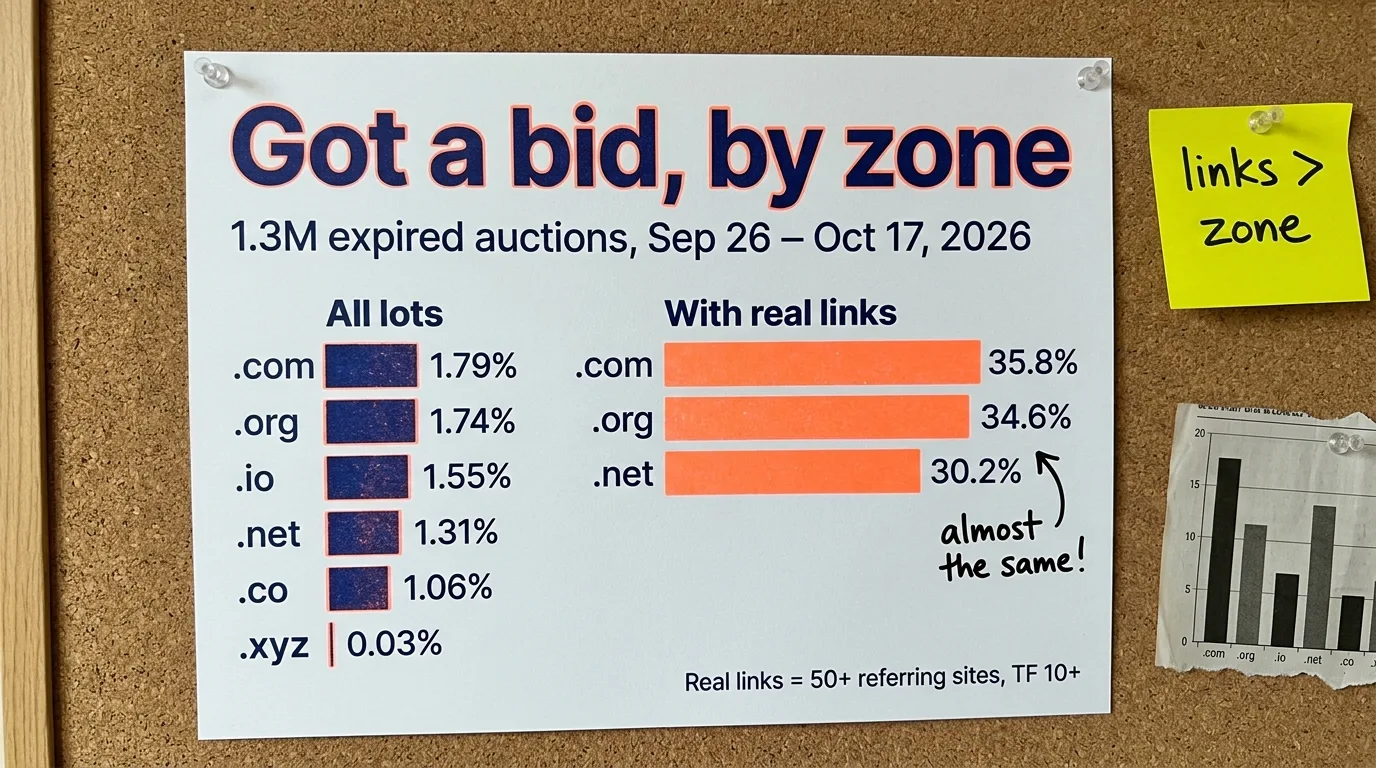
This is where opinions usually start, so we looked at numbers instead. Our sample: 1,297,328 expired auctions that ended on the largest registrar platform between September 26 and October 17, 2026. "Real links" below means 50+ referring sites and a Trust Flow (a 0–100 link quality score) of 10 or more. Prices are the last bid we recorded, usually a few hours before the close.
- .com was 59.6% of all lots. 1.79% of them got at least one bid.
- .xyz was 11.3% of lots. Only 0.03% got a bid.
- .org lots came with real links 4.5 times more often than .com: 0.32% against 0.07%.
- 387,927 lots were in newer and minor zones like .xyz, .shop, .online and .info. 0.11% got a bid, and only 36 had real links.
| Zone | Share of lots | Got a bid | Real links: got a bid | Real links: median last bid |
|---|---|---|---|---|
| .com | 59.6% | 1.79% | 35.8% (547 lots) | $80 |
| .org | 3.9% | 1.74% | 34.6% (159 lots) | $83 |
| .net | 3.8% | 1.31% | 30.2% (63 lots) | $106 |
| .io | 0.6% | 1.55% | too few lots | – |
| .co | 1.2% | 1.06% | too few lots | – |
| .xyz | 11.3% | 0.03% | too few lots | – |
So does the domain extension of a drop change its price? Here's how I read the table. A bare .com gets bids more often because people also buy names, not only links. But once a drop has real links, .org and .net draw bids almost as often as .com, and the last bids are the same or higher. People who buy for links don't pay a .com premium. They pay for the links.
The second lesson: most expired domain names in a feed have nothing to buy, and newer zones are the emptiest. Most of those lots look like cheap first-year registrations that never had a site.
A case from my own list: a .net and a .com in the same small niche (home brewing), each with 60–70 real referring sites. Both were rebuilt on the archived content, and both got back to the old traffic in about the same number of weeks. The .com cost three times more at auction.
Links belong to the exact name. If you win oldbrewery.net, the links of oldbrewery.com don't come with it. Check the profile of the zone you're actually buying.
Best TLD for SEO by Project Type
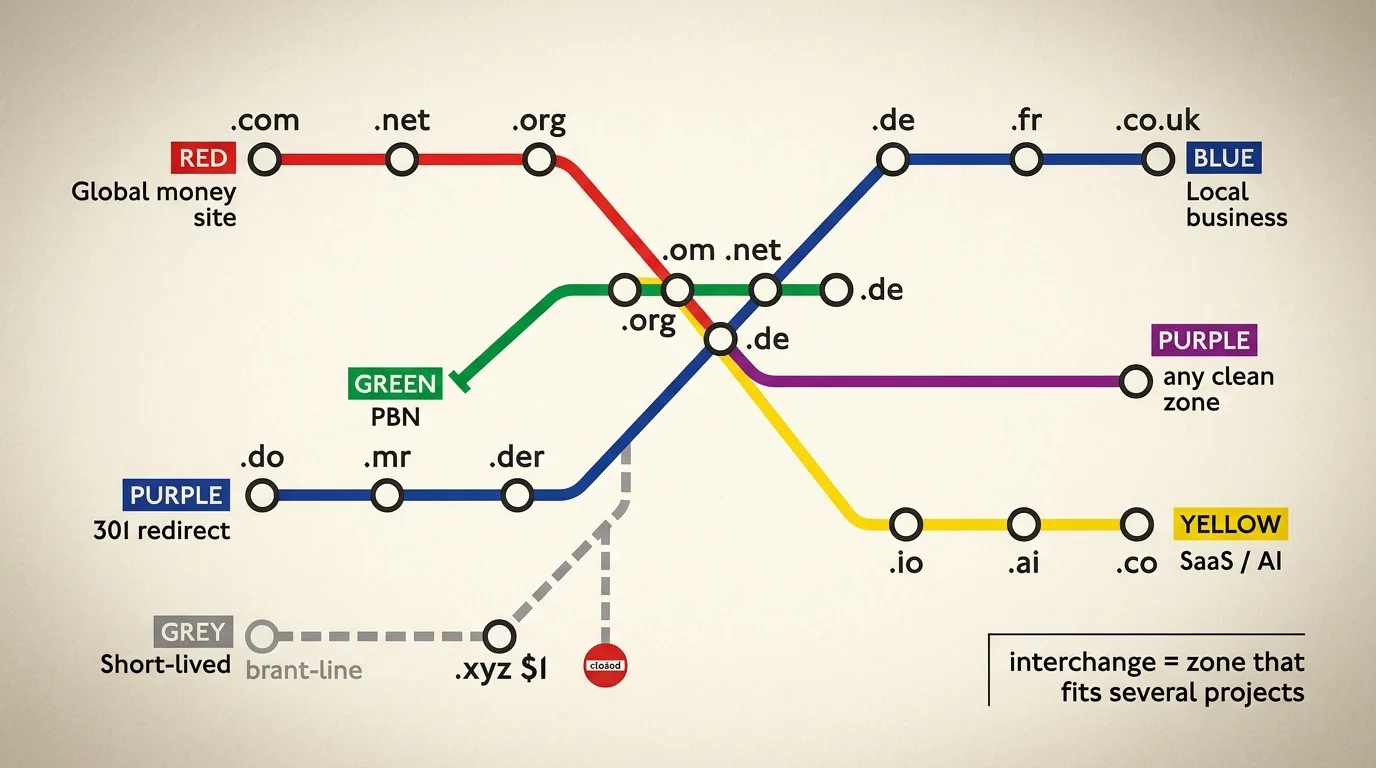
| Project | Best TLD | Why |
|---|---|---|
| Money site, global | .com, then .net or .org | Trust, type-in visits, resale |
| Local business, one country | ccTLD: .de, .fr, .co.uk | Strongest country signal |
| PBN (your own network of linking sites) | Mix of .com, .org, .net plus ccTLDs | Looks like the normal web |
| 301 redirect donor | Any zone with clean, on-topic links | Only links pass value |
| SaaS, AI, dev tools | .io, .ai, .co | Generic for Google, normal for that audience |
| Short-lived projects | Skip the $1 zones | Spam filters and ad reviews |
When you choose domain zones for a PBN, copy the real web. In our sample, drops with real links split 547 .com, 159 .org and 63 .net, with fewer than 50 in all other zones combined. A network of ten .xyz sites is a footprint, not a network
Local SEO: Where a ccTLD Wins
Expired ccTLD names are the most underrated link source for local work. A .de site that was linked from German shops, clubs and local media has exactly the profile a German money site needs. Rebuild it in German or redirect it into the German section of your site. The same links pointing at a .com look less natural.
Two cautions. Some ccTLDs limit who can register: .ca needs a Canadian presence, .eu needs an EU or EEA resident, company or citizen. And country zones release names on their own schedule, not on the .com cycle, so a drop date from a .com tool can be wrong for .uk or .de.
.io and .ai: Generic, With Fine Print
- .io. The UK–Mauritius deal on the Chagos Islands stalled in April 2026. If it goes through, IANA practice is to retire a country code when its territory stops existing, with a transition of about five years. Nobody expects .io to vanish soon, but I wouldn't build a ten-year money site on a .io drop.
- .ai. Renewals usually come in two-year terms and cost more than .com. Expired .ai names often end up in registrar auctions. Count the renewal into your bid.
.com vs .net: Check the Twin First
Before you bid on a .net or .org, look up the same name in .com:
- An active business on the .com. You'll lose branded clicks, get their misdirected emails and maybe a trademark complaint. Skip it or pay little.
- Parked or for sale. Some visitors will type .com and land there. Live with it, or buy it later.
- Free to register. Take it for about $11 a year and 301 it to your site. Wholesale .com goes from $10.26 to $10.97 on November 1, 2026, and it's still the cheapest insurance in this business.
One more pattern: .org drops often belonged to associations, schools and clubs, which is why they carry real links more often. For resale, though, .com is far more liquid.
EMD Meaning: Do Exact Match Names Still Work?
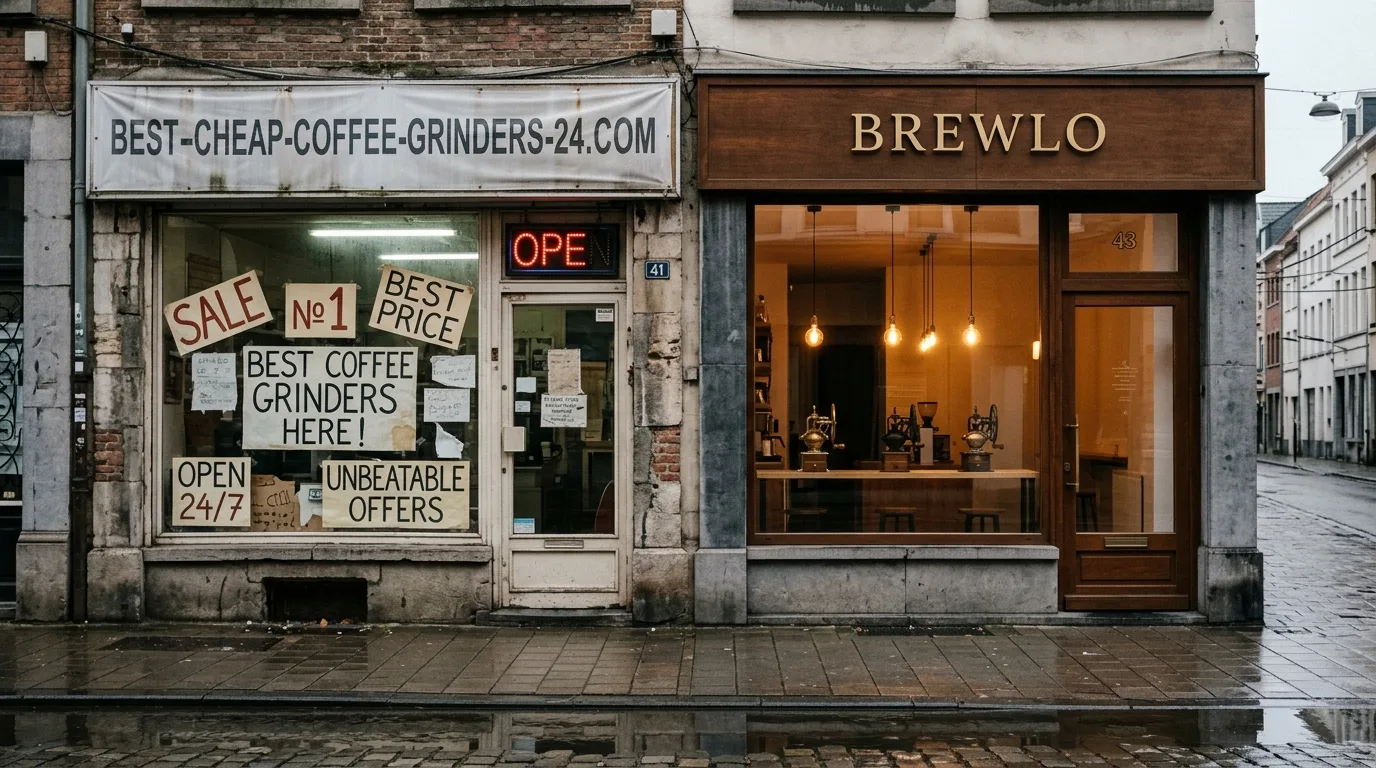
EMD stands for exact match domain: the name is the keyword itself, like bestcoffeegrinders.com for "best coffee grinders". A partial match (PMD) adds something to the keyword: grinderlab.com, coffeegrinderhub.com.
- September 27, 2012: Google rolled out the EMD update.
- 0.6% of English-US queries were affected, according to Matt Cutts.
- It hit thin sites that ranked mostly because of their name. EMDs with real content stayed.
What I see in practice now:
- No boost from the name itself. An EMD with weak content ranks like any weak site.
- Anchors are the real effect. Every natural mention of an EMD is a keyword anchor. That helps in small local niches and hurts when you add money anchors on top: the anchor profile looks over-optimized fast. With an EMD, build only with URL and generic anchors.
- A ceiling. coffeegrinders.com will never sell espresso machines in a way that looks natural. A brand can grow into any product.
- Hyphens and numbers (best-coffee-grinders-24.com) look like spam to people and to filters.
- EMD drops with spam history are double risk: a keyword name plus someone else's money anchors.
A brand domain is the opposite: a word that means nothing until you make it mean something. It's harder at the start, but any anchor is safe and the name never limits the project.
Good domain names, brand or keyword, share a few traits:
- short and easy to say, so you can hear it once and type it;
- no hyphens or numbers;
- the same name isn't an active brand in .com or in your niche;
- no trademark conflict;
- for a drop: history on your topic.
How to Choose the Right Domain Name for SEO
- Start with the project. Which country, how long it should live, whether you'll resell it.
- Pick the zone from the table above.
- Brand or keyword. A brand for long projects and money sites, an EMD for small local or one-page projects.
- Fresh or expired. A fresh registration starts clean and at zero. An expired one starts with links and someone else's history.
- Run the checks below, and choose the best of your candidates by the results, not by gut feeling.
The zone won't make SEO work for you. Put your SEO efforts into links and content; the TLD only sets the country and the first impression.
How to Check an Expired Domain Before Buying
I go from the cheapest check to the most expensive and stop at the first red flag:
- History by year. One capture per year, not just the last one. Red flags: casino, pharma or adult pages, Japanese or Chinese text on an English site, a sudden switch of topic or language, years of parking.
- Anchors. Brand, URL and topic words are fine. Money anchors, especially in other languages, mean the name has been used.
- Live links. Which linking sites still exist and still get visitors. A link from a dead page is worth nothing.
- Repeat drops. A fresh creation date with years of archived sites means the name was dropped and caught again, maybe several times.
- Index and brand. Run a site: search and a search for the old brand. If the old site doesn't rank even for its own name, a filter may still be there.
- Zone checks. The renewal price (some newer zones charge premium renewals every year), registrant rules for ccTLDs, and the .com twin.
- Redirects. Does the name already point somewhere? That can mean it's part of someone's redirect chain.
There's no SEO domain name checker that gives one honest "buy" score. Browser tools check one site at a time, which is fine for your last five candidates. For a list of hundreds, you need a platform built for drops: on deepscan.pro you can check and buy expired domains from dozens of auction sites, with history by year, link scores and spam signals next to every lot. For link data on a single name, research tools like Ahrefs or Majestic still do the job.
Best SEO Chrome Extensions for Checking a Drop
Most roundups of top SEO Chrome extensions come from digital marketing agencies and are written for on-page SEO on your own site. Search for the best Google Chrome extensions and you'll get lists of 30 or 50. Google Chrome extensions for SEO split into two kinds: tools for your own site and tools for checking someone else's. With drops, only the second kind matters: you need history, redirects, the old SEO elements and link data, in seconds.
There are hundreds of extensions available, and many SEO professionals keep twenty and use three. The best Chrome extensions for this job are boring ones that do one thing each. My list of SEO Chrome extensions for 2026 is short, and every one installs from the Chrome Web Store. These extensions work in any Chromium browser, not only in Google Chrome.
| Extension | Price | What it shows on a drop |
|---|---|---|
| Ahrefs SEO Toolbar | Free core, link metrics on a paid plan | On-page report, redirects, broken links, keyword data in results |
| Detailed SEO Extension | Free | Title, meta, headings, canonical, robots, schema |
| SEO Minion | Keywords Everywhere Silver plan or higher | Hreflang, broken links, location simulator |
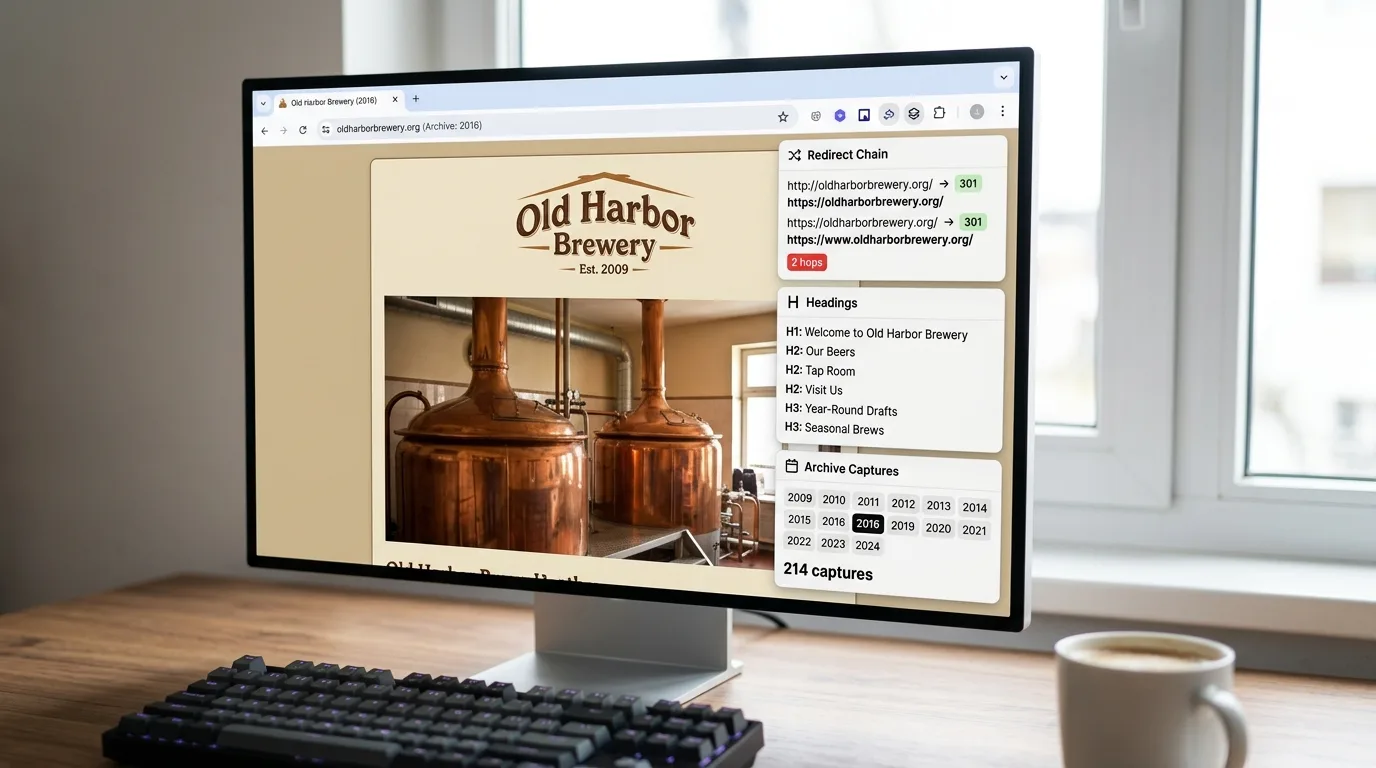
| Redirect Path | Free | 301, 302, JavaScript and meta redirects, full chains |
| Wayback Machine | Free | Number of captures, first and latest capture, calendar |
| Keywords Everywhere | Paid credits | Volume, CPC and trend next to results |
Ahrefs SEO Toolbar
The free part is a solid on-page checker: indexability, structured data, social tags, a redirect tracer, HTTP headers, broken links, Core Web Vitals and a search location simulator. On Google search results it adds keyword metrics. DR, traffic and backlinks need a paid Ahrefs plan; without one, you get the tools but not the link numbers. For drops I use the redirect tracer most: while the old site is still online, it shows where the owner already points it.
Detailed SEO Extension
Free, with no upsells and no tracking. One click shows the title, SEO meta description, headings H1–H6, canonical, robots, Open Graph and schema. Ahrefs bought Detailed in September 2025, and the founder said every current feature stays free. I also run it on archived copies: the old title and H1 tell you the real topic faster than scrolling.
SEO Minion
For years this was one of the most popular SEO extensions for Chrome: the free extension everyone installed first. Now its Chrome Web Store listing says it's "available only to customers of Keywords Everywhere's Silver or higher plan", and the rating has fallen to 1.6 out of 5 from 796 ratings. The features are still good: hreflang with return tags, broken links, a live SERP preview, a location simulator and an HTML vs rendered page comparison. If you already pay for Keywords Everywhere, keep it. If not, extensions like Detailed plus the free part of the Ahrefs toolbar cover most of it.
Redirect Path
Ayima's free tool shows every hop with its status: 301, 302, JavaScript and meta redirects, plus headers. On drops it answers two questions. Before buying: does the name already redirect somewhere? After buying: is your new redirect one clean hop, or a chain like http → https → www → final page?
Wayback Machine
The official Internet Archive extension shows how many captures a page has and opens the first one, the latest one or the calendar view in one click. About 300,000 people use it. My quick filter: fewer than 20 captures over ten years usually means a weak site, not worth deep checks.
Keyword Data Next to Every Search Result
Keywords Everywhere shows search volume, CPC and trend next to each search result and on any page, using SEO data from Google Keyword Planner and other sources. It runs on paid credits. I use it for keyword research on EMD candidates: if the keyword behind the name has no volume left, the name has no keyword value either.
WordPress SEO Plugins vs Browser Extensions
Don't mix them up. Yoast, Rank Math and similar plugins live inside WordPress and work only on your own site: titles, sitemaps, schema. A browser extension works on any site, including one you don't own yet. For drops you need the browser tools first; the SEO plugin comes after the rebuild.
None of these tools gives you a complete SEO report on a drop. A comprehensive SEO analysis of history, links and spam takes several sources. They just make daily SEO tasks faster: a free tool for each question instead of one paid tool for everything.
An on-page SEO score from an extension says nothing about a drop's links or history. Never use SEO scores as a reason to bid.
Free Chrome Extension Safety: Best Practices
Extensions get sold, hacked and silently updated. Two recent cases:
- July 2025: Koi Security found 18 Chrome and Edge extensions with 2.3 million users that tracked browsing and hijacked sessions. Some had Google's verified badge or featured placement. Most were clean at first and turned malicious through updates.
- December 2024: attackers phished a Cyberhaven employee's developer login and pushed a malicious version of the company's extension.
What I do:
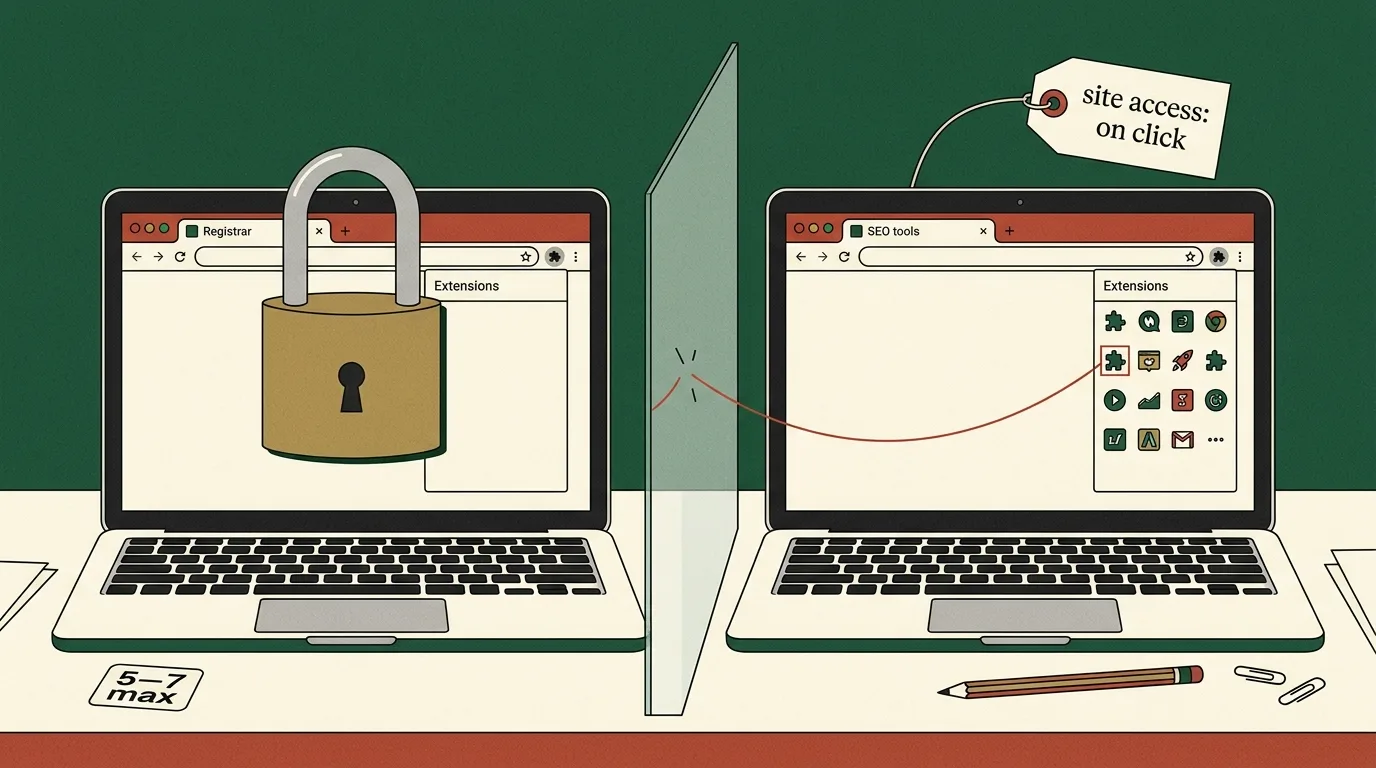
- A clean profile for money. Registrar, auction and payment accounts live in a separate profile with nothing installed, never in your main Chrome browser profile. A Chrome extension that can "read and change all your data" on all sites can read your registrar session. A hijacked registrar account means stolen names, and those transfers are hard to reverse.
- Site access "On click". In Chrome's extension settings, switch every tool from "On all sites" to "On click". It runs only when you press it.
- Five to seven extensions, not thirty. Remove whatever you haven't used for a month.
- Watch updates. If an extension changes owner or asks for new permissions, remove it and find an alternative.
If you install only one free SEO Chrome extension, make it Detailed: free, no tracking, now backed by a big company. Add Redirect Path and the Wayback Machine, and you have my whole Chrome SEO kit for drops.
After You Buy: Google Search Console and a Technical SEO Audit
- Add the site to Google Search Console on day one. Check Manual actions and Security issues: an old penalty can still be there, and lifting it takes a reconsideration request that explains the new ownership.
- Find old URLs with links in the archive and in your link tool. Rebuild or 301 the ones that still get links; let the rest return 404.
- Run a quick technical SEO audit: https works, redirects take one hop, robots.txt doesn't block the site, a sitemap is submitted. Then fix website SEO basics: titles, internal links, unique content.
- Wait two to four weeks. Track SEO performance in the Performance report before you point the drop at a money site. If impressions stay flat, the name is filtered, and you've just saved your main project.
The right SEO setup for a rebuilt drop is boring: real pages, the old URL structure where it had links, and no money anchors for the first months.
White, Grey and Black: How the Zone Fits Each Approach
White. A brand .com or a local ccTLD, the old project rebuilt on the same topic, the .com twin registered. Slow, safe and the easiest to resell.
Grey. A PBN or redirects. Mix zones the way the real web does, use ccTLD drops for local links in that country, spread registrars and hosting. Most SEO strategies built on drops fail at the checking stage, not at the buying stage.
Black, and only with care. Churn-and-burn sites on cheap newer zones, or drops with strong links reused for casino and pharma. Google's spam policy on expired names targets exactly this: a name bought "primarily to manipulate search rankings" with content of "little to no value". Such sites live for weeks. Keep them in a separate registrar account, far from your money sites, and spend only what a few weeks of traffic can return.
FAQ
Does the TLD affect rankings?
Not directly. Google treats all generic zones the same way, and keywords in a TLD give no advantage. A ccTLD adds a country signal.
Is .com better than .net?
Not for rankings. .com gets more trust and type-in visits and resells faster. With real links, .net drops drew bids almost as often in our data: 30.2% against 35.8% for .com.
Are .io and .ai safe to use?
Google treats both as generic, like .com. Keep in mind the political risk around .io and the two-year renewals of .ai.
What is the EMD meaning in SEO?
EMD is an exact-match name: the address equals the keyword. Since the 2012 update it gives no built-in boost, and it pulls keyword anchors that are easy to overdo.
How do I choose a domain for SEO?
Start with the country and the lifetime of the project, then pick the zone, then brand or keyword, then check history and links before you pay.
What are the best SEO tools for checking a drop?
For one name: Detailed, the free part of the Ahrefs toolbar, Redirect Path and the Wayback Machine. For long lists: a bulk platform with history and link data.
Key Takeaways
- The TLD isn't a ranking factor. A ccTLD is a country signal, nothing more.
- For drops, links decide. With real links, .org and .net got bids nearly as often as .com.
- Newer zones rarely carry real links: 36 lots out of 387,927 in our sample.
- An EMD gives no boost by itself. Build it with URL and generic anchors.
- Check history, anchors, live links and the .com twin before you bid.
- Keep registrar accounts in a browser profile with no add-ons.
Comments
Sign in to leave a comment
No comments yet — be the first.