Free Domain Age Checker Tool: Find Website Age & Registration Date
A domain age checker shows the registration date, not the real past. See how WBY, ABY, and a drop reset differ, and how to check an expired name before you buy in 2026.
 DeepScan.pro
A domain age checker reads one clock. The live site has another. If you buy on the first number alone, you pay for a year that was wiped.
It is the time since the current registry record started. Age refers to the length of that registration, not to the first day a page existed. Age refers to how long this registration has been continuous. The age of a website's domain can look old while the website's age is a parked placeholder. Those are different facts. Treat them that way.
Key point: Registry age and archive age are not interchangeable. One resets. The other remembers.
What Domain Age Refers To
On ExpiredDomains and in auction rooms the split has names.
WBY is Whois Birth Year: the year in the creation field. ABY is Archive Birth Year: the year of the first real Wayback capture, not a parking template.
| Pair | What you are looking at | What I do |
|---|---|---|
| Old WBY, old ABY | Continuous established domain | Shortlist, then links |
| Old ABY, new WBY | Dropped and registered again | Price it as history, not as age |
| Old WBY, thin ABY | Years of parking or an empty DNS | Do not pay an age premium |
| New WBY, new ABY | New domain, or a newly registered domain | No inherited story |
How Domain Ages Get Misread
I compare prices only after the years are on one line. Raw domain ages from the registry and archive domain ages from Wayback both go in the sheet. I sort domain ages into four buckets. Matching domain ages are the clean cases. Split domain ages, where the archive is older, are drops. Inflated domain ages with no real snapshots are parked names. Tiny domain ages on both clocks are new. An older domain only helps if those years were spent as a site.
WBY is the live registration
Since 28 January 2025, gTLD registries are not required to run port-43 WHOIS, except .com, .name, and .post. RDAP is the required service. A lot of checkers still say "WHOIS" on the button and query RDAP underneath. Country endings were never in that mandate. As of late 2026, .de, .io, and .co often still answer on the older protocol.
A Free Tool Can Return Nothing on Some Endings
If it returns nothing, the ending is the usual reason, not a dead name.
Registrar Records Can Disagree
A 2024 comparison of the two protocols found inconsistent data on important fields, including the creation event and nameservers, on about 7.6% of names. On a buy I care about, I read RDAP and a second lookup. One screen is not enough when the year is the price.
The field that matters is the registration event. People still mix it up with "Updated". An update fires when nameservers or contacts change. It does not make the name younger. The domain's age stays on the registration event.
Expiry Date Is Just the Paid-Through Line
Expiration date is the same idea in another label. Neither tells you when the site started. A name expiring in 2035 can still have been a coupon farm last spring.
Why Domain Age Matters for the First Page of Google
It is a filter. It does not rank the page. Google has said for years that the year by itself is not a lever. Search engines like Google store links, indexed URLs, and a prior state of the host. The year is only a clue that those things might exist.
SE Ranking's read of the March 2026 spam and core updates is the useful picture. Top-10 age barely moved. Names older than 15 years still fill most of that page. That is accumulated links and content, not a birthday bonus. About 82% of domains knocked out of the top 100 by the 24–25 March spam update were still out after the core update (27 March–8 April). A higher domain age would not have saved a thin rebuild.
The latest spam pass ran 24 September–8 October 2026. No new written policy. The March 2024 expired-domain rule is still the one that bites: buying a name and repurposing it mainly to move rankings, with little value for users, is spam. Same-topic sites with real pages are outside that sentence. A 301 from an unrelated host into a money URL is inside it.
John Mueller, autumn 2025, on names that sat unregistered or parked: Google keeps that state for a while. There is no manual reset. You ship the site and bring visits from somewhere else while the record catches up.
Warning: A footer that says "since 2008" is decoration. One registry call exposes it. Do not build trust copy on a year you do not have.
Age Checker Tools and a Website Age Checker
They are not all the same product. One of them often prints the registry year and calls that the life of the site. An age checker is a tool for the registration event.
The Age Checker Provides the Registration Event
Nothing in that line describes the pages. It does not open the archive.
Using a Domain Age Checker
Pull the live registration before you open backlinks or an auction tab. If the year is already disqualifying, the rest of the work is wasted.
Check Domain Age Instantly, Then Leave
You only needed the live year. The archive is the next tab.
Check How Old Any Domain Looks Before You Pay
Read the pages, not just the invoice. A parking template is not a business.
When to Use Domain Age
I use it to throw out obvious mismatches, nothing more. A ten-year parking page and a ten-year publication are not the same buy. The year only tells me which file to open next.
Use This Domain Age Beside the Archive
Keep the number next to ABY.
Use Our Free Domain Age Read as a Start
It is a starting point, not a verdict. Simply enter the domain name with no protocol and no path. Enter a domain once, then repeat the same string on archive.org. Type it in lowercase. Use punycode if it is an IDN.
This Domain Age Checker Is Completely Free to Use
For one name, yes. For a list during a live auction, open a bulk view instead of clicking one by one.
Bulk Domain Age Checker
ABY and WBY columns on ExpiredDomains are faster than a manual loop. That column is still only the registry year. Open the outliers yourself.
[Изображение 2 — после блока Bulk Domain Age Checker, перед сбросом даты]
Промпт: Современный тёмный интерфейс в молодёжном профессиональном стиле, 16:9, как рабочий инструмент, а не рекламный баннер. Таблица из шести строк: колонки Domain, WBY, ABY, Gap, Topic. Две строки зелёные (годы рядом, тема tools), две янтарные (ABY 2013, WBY 2026, пометка dropped), две красные (парковка, мало живых снимков). Крупные цифры, чистая сетка, мягкий свет монитора, без логотипов брендов и без мелкой нечитаемой каши.
The Age of a Domain Resets on a Full Drop
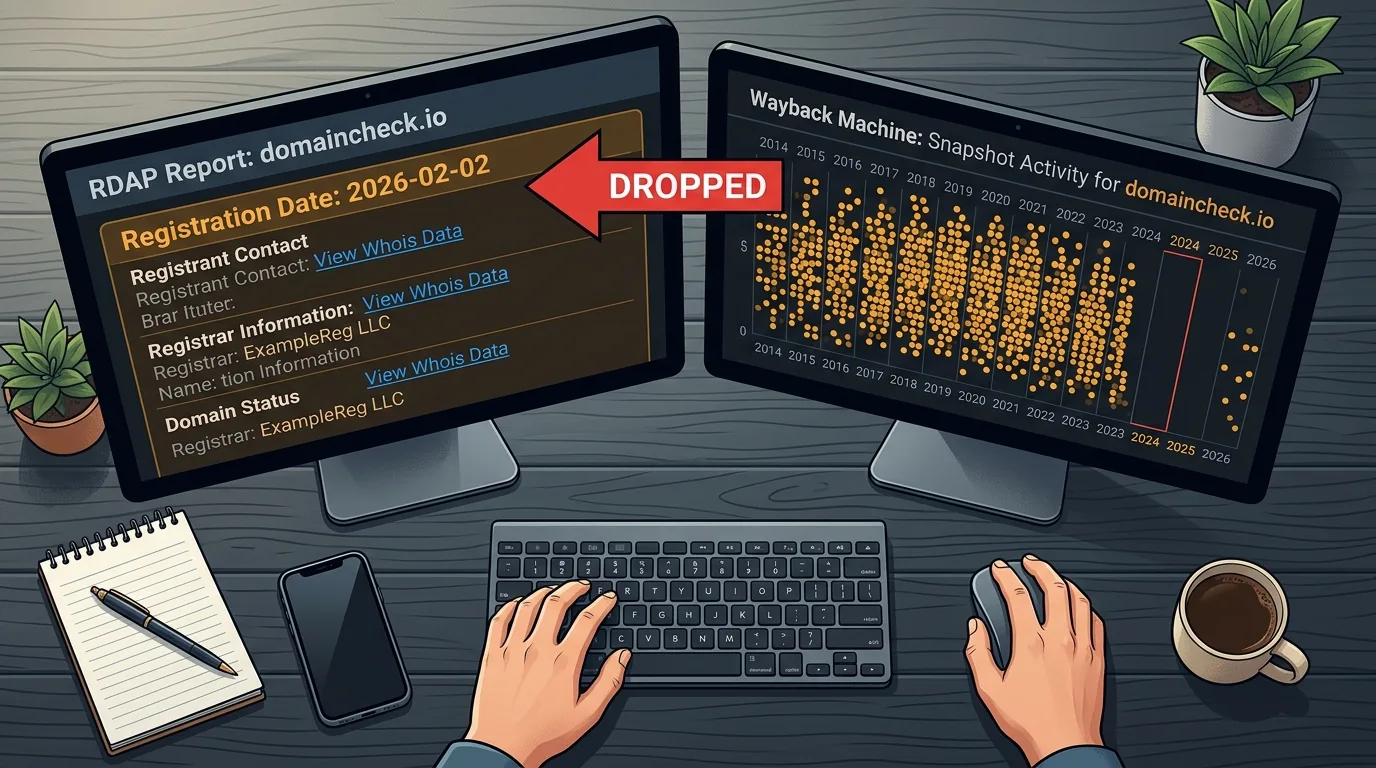
In RDAP, what you see is the time since a domain object was created and not deleted. Renewals do not reset it. Transfers do not reset it. A full drop does.
Dynadot's help, updated 4 August 2025, is plain: win their expired auction and that field stays, because the name never went back to the pool.
The Creation Date Stays If You Buy Before the Drop
Same idea at GoDaddy closeouts, NameJet, and SnapNames, when you take the name before pending-delete finishes. You are continuing a record.
Catch it after the purge and you are creating a record. The domain creation date becomes today. The domain was first registered years earlier, but that original year is gone from the live file. The domain name was first registered on a date you will only see in a historical log. Both of those older facts can be true. Only one year shows up in a normal checker.
The Domain Was Registered Again This Morning
That is the only sentence the live record supports. Put today's year in the sheet. If the seller quotes 2011, they are reading the archive or a historical log, not the current file.
Rough .com path, which the holder can stretch:
- Expiry, then an auto-renew grace of about 30–45 days. The old owner can still renew.
- Redemption, often another 30 days, with a restore fee.
- Pending delete, about 5 days. Nobody renews it.
- Purge. The next domain registered at the standard price gets a new registration event.
Tip: If the auction says "expired" but the name has not hit the pool, you are buying the old registration age. If it is a backorder on a drop, you are buying the archive and the links, not the year. Do not let a seller blur those.
Check the Age on the Live Record
Then put that year next to the first non-parking capture.
Older Than the Domain Registration Date
Then the name was deleted at least once. Do not pay for "unbroken history." The registry already closed that argument.
The Original Registration Date Sits Outside RDAP
It lives in a historical log (DomainTools, WhoisXML, and similar), not in the current RDAP. I still say WHOIS for that archive out of habit. That paid look is worth it before a four-figure bid.
A Normal Domain Age Check Misses the Last Cycle
It will not show the previous registration. On a large bid, pay for the historical log. The free screen stops at the current object.
Registration history also shows serial churn. Three drops in six years means the "brand" was a sequence of short projects. I walk away more often here than on a single clean lapse.
What the first snapshot is not
ABY is not a launch date. The archive crawls what it finds. A site can be two years old before the first capture. The October 2024 attack on the Internet Archive left a hole; the machine came back read-only on 14 October 2024. A blank week there is not proof the site died. In September 2026 the archive started returning 429s under heavy bot traffic. If your scraper "proves" there is no history, open the calendar in a browser before you believe it.
Ignore parking captures: Sedo, Bodis, GoDaddy parking, Dan, Afternic, HugeDomains "buy this domain" pages. They make ABY look real. They are not a site. A long 403 often means the owner blocked the archive bot, which is common on doorways. A gap of a year or more, then a new topic, is a change of hands even when the registry year never moved.
Check Website Age on the First Real Page
That date, not the parking dot, is the one I write down. Skip "this name is for sale" captures. The first page that actually explains a product or a topic is the year I keep.
Before the Invoice Clears
Expired domains are not one product. Expired domain names still inside grace or redemption can keep the old year if you take them at auction. Expired domains that already dropped cannot. Learning how to check expired domain before buying is the difference between those carts.
Do it in this order. Skip none of it on a name you cannot afford to burn.
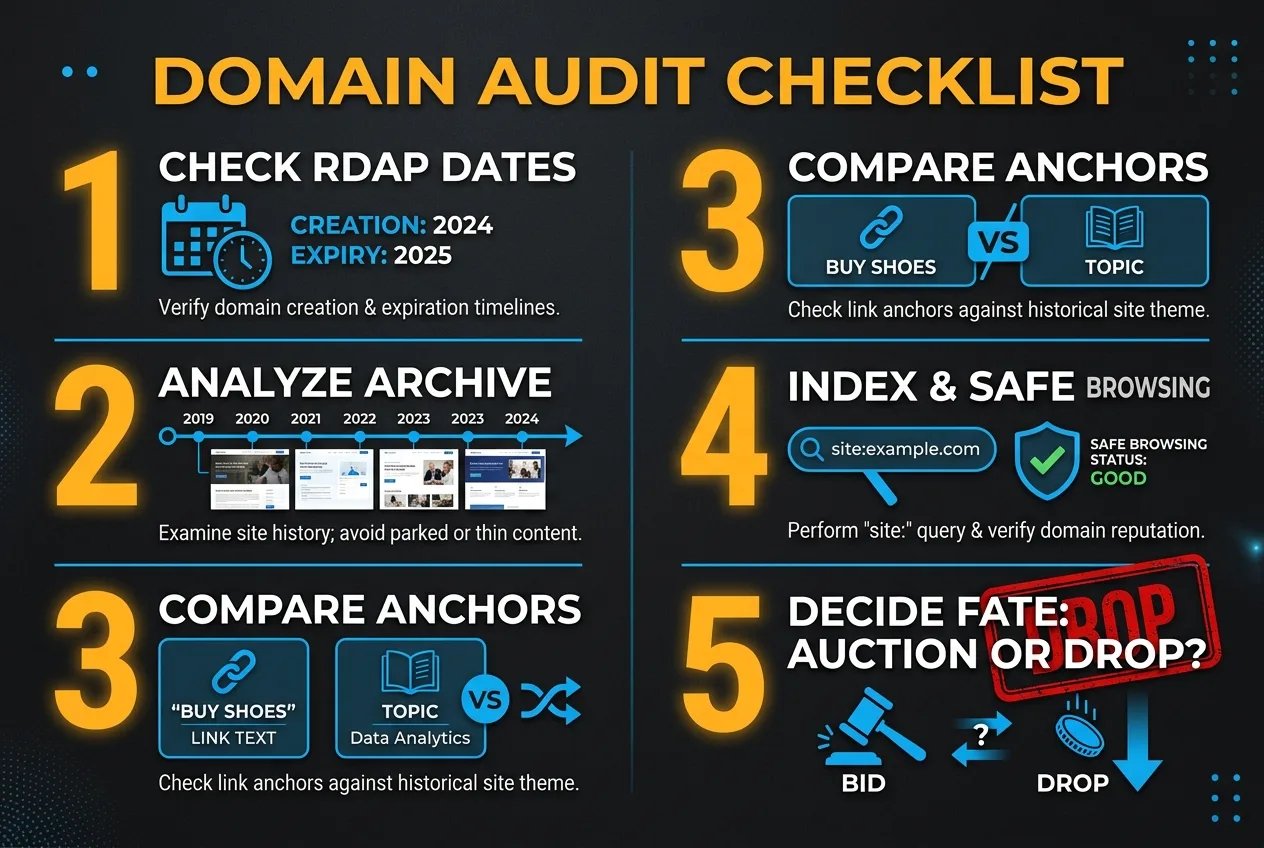
- See the domain in RDAP. Write down the registration event, the paid-through field, status codes, and the company that holds it. pendingDelete and redemptionPeriod tell you whether the year can still be saved.
- Open the Wayback calendar. Mark ABY, the last real capture, topic shifts, and any 301 that lasted more than a month to an unrelated host. A www or https hop is noise. A two-year redirect to a casino is the asset walking out the door.
- Compare anchors to that topic. Links that say "student loans" on a former bakery are not a gift. They are the footprint.
- Run a site: query and a Safe Browsing check. A manual action does not always show, so a dead index plus a spam archive is enough to pass.
- Decide the lane: continue the record, or buy a reset name and treat the live year as starting today.
The domain may look perfect in a checker and still be a 2024 doorway that blocked crawlers. The registry line is not the whole job. You already saved the year. Now read pages.
Four buys I still see in 2026
White. You want the exact string for a real project in the same narrow topic. You keep URL paths that already earned links, you write new pages, you do not pour it into an unrelated offer. The year is a side effect of a continuous record. This is the only use that sits clearly outside the spam policy.
Gray. You intercept before deletion so WBY survives, rebuild the old URLs that have referring domains, and stay on topic while you replace the copy. Google can still decide the move was for rankings. Stay close to the old subject and make the pages useful, or you slide into the next bucket. Historical logs matter here: they show whether the domain name has been registered to a string of unrelated owners. If the domain has been registered across five niches, the links are rented reputation.
Black, and mostly a tax in 2026. The pattern is familiar. Drop-catch a name with a pretty ABY, ignore the new WBY, 301 the whole host to a money page, or stack these into a private network. Mueller already described the unregistered state. The March 2024 policy names the repurpose. The March 2026 spam update moved in under a day, and the September–October 2026 pass ran the same rules. A network of reset names does not inherit 2012. It inherits a gap.
What does not work, and still gets sold:
- Backdating a registry. You cannot. The exact age is theirs, not yours.
- Buying a dropped "20-year" name and quoting WBY. The seller is quoting ABY.
- Hiding a spam year by blocking the archive now. The captures are already stored.
- Swapping topic overnight and hoping the old anchors still pass.
Warning: Redirecting an unrelated expired name into a site you care about can sample the main site, not just the expired one. Keep experiments off the property that makes money.
SEO Tools Do Not Replace an SEO Analysis
An SEO page checker looks at the live URL: indexation, titles, internal links, speed. It will not tell you the host was a pharma doorway in 2019. Do not substitute one report for the other.
Domain age is one input. Domain age is just one line in that report.
Age and Domain History Next to the Status
A redemption flag plus a clean archive is a different risk from a name that has sat in pending delete twice. That record has to sit beside age and registration status.
Age of Any Domain You Did Not Open
If you did not open it, the number is a rumor. A screenshot in a pitch is not a calendar. Open the capture yourself.
How Old a Domain Feels in a Pitch
That feeling is not how long a domain name has actually been a website. Ask how many years it stayed on one topic. The domain name age printed on a lander is marketing if it is not the registration event.
Domain Authority Is Only a Sort Key
That third-party score is not a Google number. I use it only to sort a list, then I open the links. A high score on a reset name is often the previous owner's graph, which may already be ignored.
What a Stable Aged Domain Looks Like
On 9 October 2026 a public lookup of backlinko.com showed a registration of 28 September 2011, paid through 28 September 2035, at MarkMonitor. That is the raw record you want: one long registration event, a long paid-through line, no reason to invent a story. Your candidate should be this legible. If it is not, you do not understand it yet.
Domain Age Alone Will Not Rank You
Links and a real archive do the work. A young host with better links will pass an old shell that only has a year to brag about.
Check the Domain Age, Then the Gap
The call gets simpler once the two clocks are on paper. Find out when a domain was created in RDAP. Find when a domain first had a real page. If those years disagree, believe both, and price the gap.
The domain age checker retrieves the live registration. A domain age checker to find the previous life does not exist in one click. The old year means the archive plus a historical log.
Domain Age Tool Output Is Not a Rank
It is the start of the job, not the end. There is no rank in the timestamp.
Check Age Only If You Name the Clock
Say which one you used. The age of the domain you publish in a case study should name its source and its age in years, plus months if the name is young. "About 10" is how bad buys happen.
An old domain with a dirty archive is more expensive than a young clean one, because you will spend the money twice: on the name, then on the recovery. An older domain that never dropped, stayed on topic, and still has referring domains from that topic is the short list. Everything else is a story about domain ages that someone wants you to mix up.
The page, the links, and the gap since the last real capture decide the bid. The checker only tells you whether the seller is describing this registration or a dead one.
Tip: Write two numbers in the sheet, every time. WBY from RDAP. ABY from the first non-parking capture. If you cannot explain the gap in one sentence, do not buy.
Sellers will keep using the year as a slogan. You now know which half is the registry, and which half is the archive.
Comments
Sign in to leave a comment
No comments yet — be the first.