Many people consider the terms “expired,” “dropped,” and “deleted” synonymous. But they are not. If you buy a domain at the wrong stage, you may overpay or try to catch a name that still belongs to another owner.
This guide takes into account current rules, official timeframes, and important verification details. If you landed here from searches like “what is an expired domain” or “what is a drop domain,” know this: they all point to the same stages of the process.
The main rule: every dropped domain once had an expired registration, but most expired domains have not yet been dropped.
Difference between expired domains and dropped domains
Why isn’t the domain name free yet?
An expired domain is a name whose paid period has ended. Its record still remains in the registry. The owner can often recover it during a grace period or redemption period. You cannot simply register such a domain the same day.
A dropped domain is one for which all deadlines have passed. Its record has been removed from the registry, and the name has returned to the general pool of available domains.
Expired domains are listed at auctions. A domain that can be registered for the standard $12 is already a dropped domain. If you confuse these concepts, you can bid on a name that cannot be obtained, or wait for a domain to be released that has already been sold.
What the domain life cycle looks like after expiration
A domain does not become available for registration on the next morning after its expiration date. Expiration is only a date in the registry record, not the moment a name is released. The ICANN Expired Registration Recovery Policy defines the process for .com domains and other generic top-level domains (gTLDs).
Before expiration, the domain works (resolves to an IP address). It can be renewed at the regular price. If you plan to keep the domain, turn on auto-renewal.
Day 0. The domain has expired. It is now an expired domain. It is neither available nor deleted.
Grace period (about 30–45 days). Most registrars allow the owner to renew the domain at the standard price. DNS records may be deliberately disabled so the owner notices the problem. Domain auctions often take place at this stage as well. If nobody wins the auction, the registrar sends a request to delete the domain from the zone.
Redemption period (30 days). After the delete command is sent, the redemption period begins. The site stops working. In addition to the renewal cost, an additional redemption fee is charged (usually $80 to $200). Third parties cannot get the domain simply by paying this fee; only the original owner can restore it.
Pending Delete status (pending deletion, 5 days). The next stage is domains pending deletion (status `pendingDelete`). During this period, the domain is not restored or re-registered, but domain catchers (drop-catching services) are already queuing up.
Moment of release (about day 75–80). The domain becomes free and returns to the general pool of names. At that moment, the “first come, first served” principle applies. Valuable .com domains are taken within a second; the rest can be registered with a regular registrar.
For country-code domains (ccTLDs), different timeframes apply. Do not apply the .com calendar to all top-level domains.
What the “expired” status means: expired domain names, grace period, and redemption period
The “expired” status does not mean the domain is free to register. It means the registration period has ended and the domain is in one of the intermediate states: grace period, redemption period, or pending deletion stage.
Marketplaces often label domains at any of these stages as “expired,” and sometimes even ones that have already been dropped. That is why people try to buy a domain that can still be restored.
Look at the status, not the label:
- `autoRenewPeriod` — the grace period is open; renewal at the regular price is still possible.
- `redemptionPeriod` — the redemption period is open; the domain can be restored, but it is expensive.
- `pendingDelete` — the deletion process has started; the domain can no longer be saved.
- No record — the domain has already been dropped; register it or accept that you missed the opportunity.
Until final deletion occurs, you are dealing with the secondary market or placing a backorder.
What is a “drop”? It is the moment a domain is released after its registration expires
A “drop” is final removal from the registry (purge). In registry operator language, it means the object no longer exists, and any accredited registrar can submit a create (registration) request for it.
People say a domain “dropped,” meaning its registration expired at GoDaddy. These events may be weeks apart. A domain can expire in March, sit at auction, and only drop in June. Or it may never drop at all if someone pays to restore it.
A backorder is not a reservation. It does not hold the domain for you. If several people place the same backorder, the drop-catching service will run an internal auction. You are paying for a chance (a ticket), not for the domain itself.
In October 2025, GoDaddy discontinued its standalone backorder service. In 2026, you can either participate in their public auction or use drop-catching services on platforms such as DropCatch, SnapNames, NameJet, or Dynadot.
When a domain finally drops, winning an auction is not a substitute for proper due diligence. You become the owner of a dropped domain, but you do not yet know what links point to it, whether there are trademark issues, or whether search engines trust it.
Watch drop lists if you are looking for expiring options. Recently expired domains in such lists are not yet available for public registration.
Deleted domain names: the concept of “delete” and buying a deleted name
The word “deleted” is imprecise. It can mean three different things.
Add-grace cancel. You register a domain, change your mind within five days, and delete it. Fees are often refunded. The 80-day period does not start.
Registrar action. The registrar instructs the registry operator to delete the expired domain. This deletion starts the 30-day redemption period. WHOIS/RDAP data will show the status `redemptionPeriod`, not “deleted”.
Final purge. In some lists, a dropped domain is called “deleted,” meaning you can register that name at the standard annual price.
If a seller offers a dropped domain “with 12 years of history” (12 years old), clarify: did the creation date remain unchanged, or was the domain deleted and re-registered last week? These are different assets.
Domain security concerns remain relevant even after a name is deleted: trademarks, the UDRP process, and old spam complaints do not disappear just because the domain record was removed from the database.
“Old” domain vs. new (and what a “fresh” domain is)
Age is history. Expiration is a reference point.
A “fresh” domain is a name without a significant past: empty archive, no “brand trail” from previous owners.
The choice is simple. An old domain may have backlinks and an indexing speed advantage. A new domain is a “clean slate.” Choose the old option only if its previous topic matches yours, the links look natural (editorial), and the name itself is not a registered trademark. If at least one of these conditions is not met, it is better to start with a clean slate.
Google does not rank sites based on their creation date. The search engine evaluates pages, links, and useful content. John Mueller has noted that the fixation on domain age is mostly characteristic of those who resell old names.
A domain that you re-register after it has been dropped becomes a new object. The creation date is reset. However, backlinks may still point to that domain. Think of it as a history with an interrupted chronology, not as a clean slate.
SEO value, domain quality, and backlinks
Google’s March 2024 expired-domain abuse policy is still the key SEO rule in 2026. Abuse means buying expired domains and putting thin, off-topic content on them to borrow old authority. Building a real site on a relevant topic is fine. The March 2026 spam update did not add a new category. It accelerated detection.
The DA metric on a marketplace is advertising. Quality shows up in active referring domains, clean anchors, and a Wayback chain that matches your niche.
Check domain authority and domain rating if you want to quickly filter domains, then ignore them as soon as they don’t match the archive. A DR 50 domain for $12 is usually a warning.
A pre-purge auction keeps the registration continuous. That is a stronger SEO asset. After a reset, you are using the old thread on a new object. Both can work. Only the first preserves the creation date.
How to check an expired domain before buying
Checking an expired domain before buying is an important step that will save your bid. Check everything in order. Stop at the first “no.”
Check whether the domain is actually available.
- First use RDAP (WHOIS is a fallback starting in 2025). Read “ok,” “autoRenewPeriod,” “redemptionPeriod,” “pendingDelete,” or a 404 error.
- Open the Wayback Machine. Adult, pharmaceutical, casino content, or topics you will not continue are a “no.”
- Search for site:thedomain.com. Zero results for a once-real site is a warning.
- Get an up-to-date backlink profile. Count backlinks from unique hosts, not total links. Exact-match spam anchors are a “no.”
- Search trademarks — look for a unique word. “Catch” is not a defense against UDRP.
- Check blacklists and old nameservers.
- Include the TLD renewal price, not just “Catch.”
- Write one sentence describing the use. If the sentence sounds like “301-redirect it to my main site,” choose a clean domain name instead.
Domains listed for sale on the secondary market and available domains are not the same thing. One is still owned by someone else, and the other is not. A listing’s expiration date is not the day you can register the domain.
Finding and buying expired domains
Use registrar auctions, pending-deletion feeds, and backorder services. Run the checks described above first.
Buying an expired domain at auction
This path preserves continuity. You pay for the asset before it is finally removed from the registry. Set a realistic budget in advance.
Buying an expired domain or placing a backorder
A domain in the grace period usually goes through an auction. For domains pending deletion, place a backorder. If a .com domain with good metrics has already dropped, simply register it. If such a domain costs $12, consider that the window for a bargain has been missed.
Do not let the brand you need expire. Do not wait for expiration if you can renew the domain today. And do not treat the terms “expired” and “dropped” as interchangeable on sales pages.
Frequently asked questions about domains
- Are “expired domain” and “dropped domain” equivalent? No. “Expired” means the registration period has ended, but the domain is still being processed. “Dropped” means the registry has permanently removed it.
- How long passes from expiration until anyone can register it? For a typical .com domain, about 75–80 days if it is not sold or restored. After registrar action, the minimum period is 35 days.
- Do expired domains help SEO? Yes, if you continue to develop a real topically relevant site. No, if you want to use old authority for thin pages.
- What if you need to delete an active domain? That is possible. It is important to understand which deletion scenario will apply: the five-day add-grace period after registration or the long deletion process after expiration.
- Can someone take the domain after I have caught it? Not through the redemption process. However, a UDRP complaint may be filed against you if you registered a domain containing someone else’s trademark.
- Which checks are the fastest? RDAP, Wayback Machine, a `site:` query, referring-host count, and a trademark database check. If anything raises doubts, skip it. Another domain will drop tomorrow. Domains drop daily. Let bad domains go. Buy rare, valuable domains without hesitation. Some domains drop quietly. Others in intense competition. Now you know the difference.
 DeepScan.pro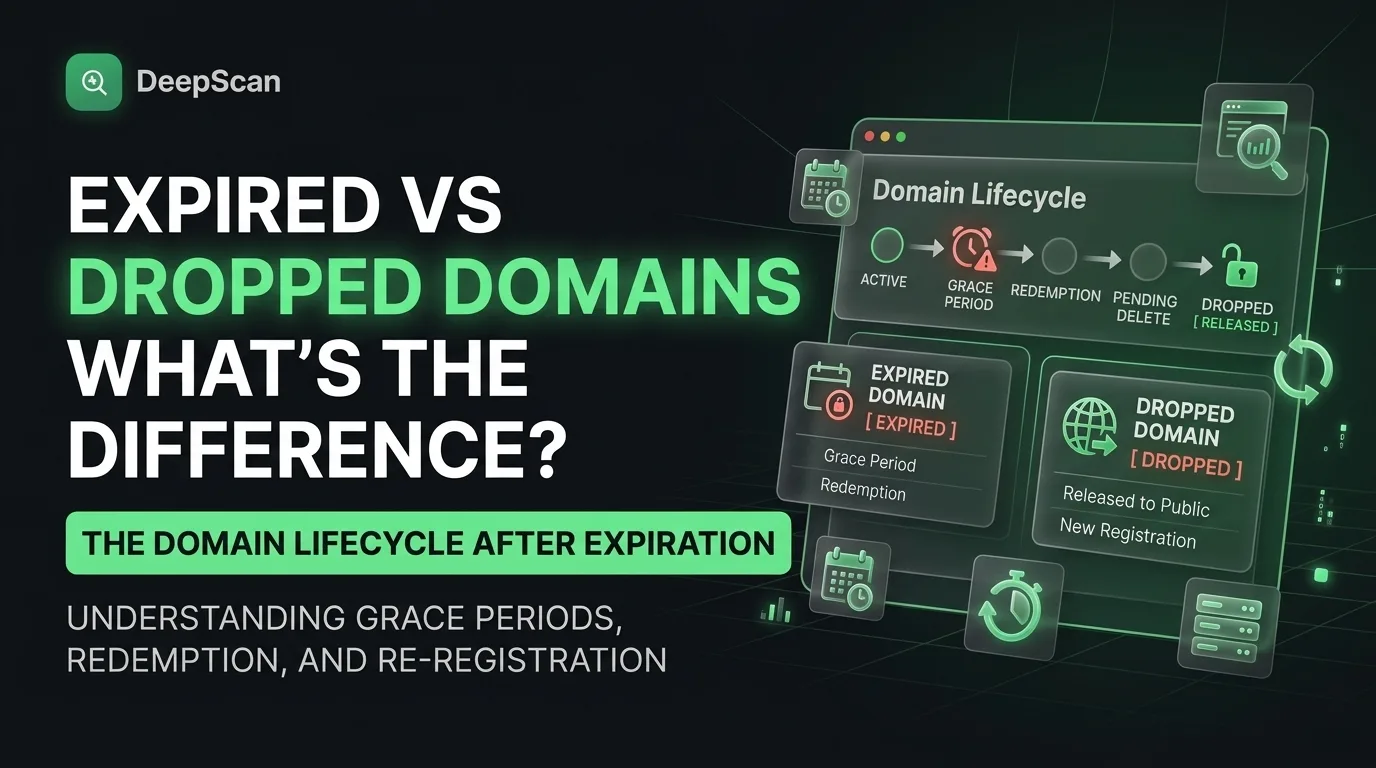
Comments
Sign in to leave a comment
No comments yet — be the first.