Best Domain Auction Sites for Expired Domains: 8 Platforms Compared
Eight places to buy expired domains, compared on real 2026 fees and rules: GoDaddy, NameJet, SnapNames, DropCatch, Dynadot, Namecheap, Sedo and Afternic. Where each gets its names, how to predict where a domain will go, a pre-bid checklist and bidding tactics that save money.
 DeepScan.pro
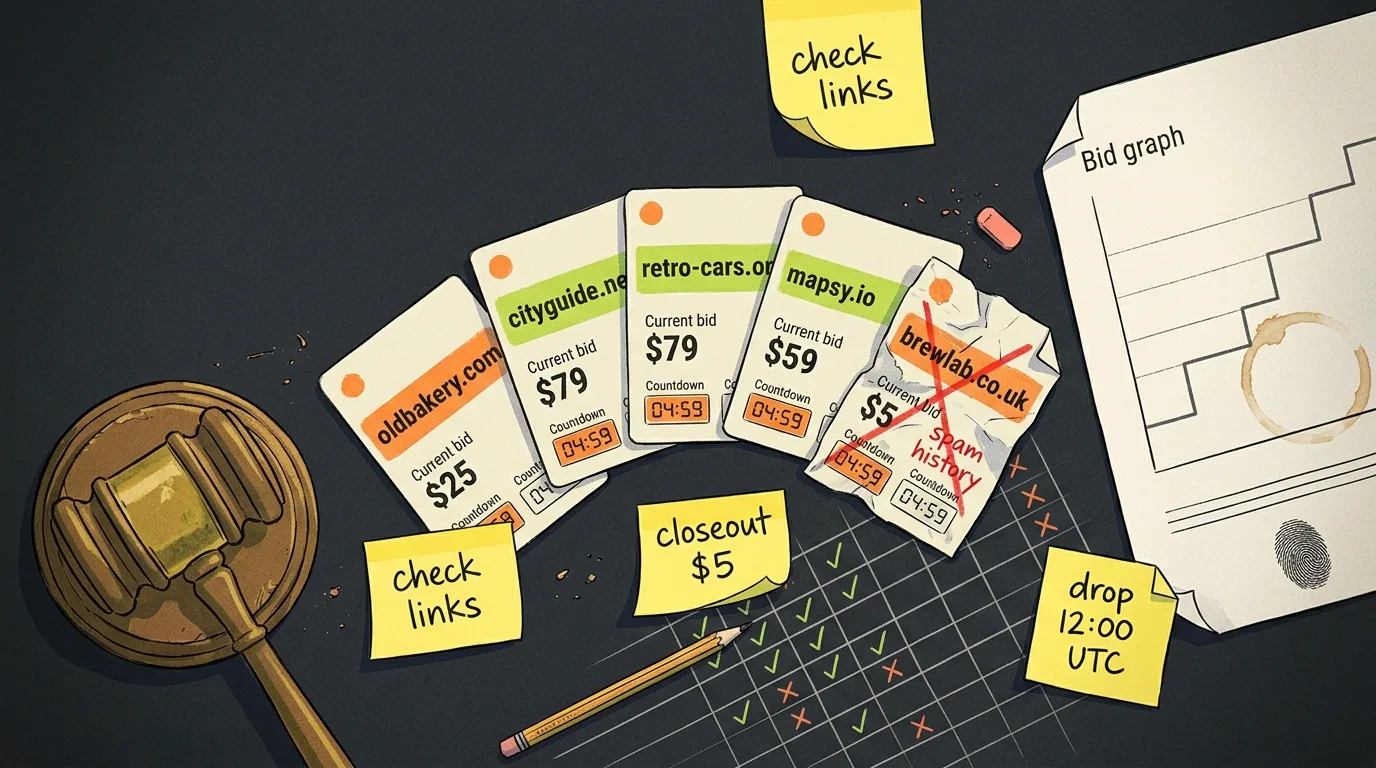
At every stage of its life, an expired domain is sold in exactly one place, and you don't get to choose which. The registrar (the company where the name was registered) decides that. This is why inventory looks so different from site to site, and why anyone who only checks platforms like GoDaddy Auctions sees maybe half the market.
Thousands of names expire every day. Below I break down the eight places where I actually watch them and buy: where the names come from, what they really cost, and where extra money quietly leaks. Then come my pre-purchase checklist and the rules that have saved me the most. The goal is to show which of the best platforms help you find and buy expired domains worth the money, and which mostly sell noise.
Prices and rules are checked against the platforms' own help pages as of October 2026. Fees change often, so check again before a big purchase.
Quick Comparison of Domain Auction Platforms
| Platform | Where the names come from | Entry price | Hidden costs | Best for |
|---|---|---|---|---|
| GoDaddy | Its own and partner expirations (29 sources) | $25 starting bid, closeouts down to $5 | Renewal on top, $4.99/yr membership | The biggest pool of aged domains |
| NameJet | Network Solutions, Register.com, Bluehost, HostGator and others | about $69–79 | Closed auction if 2+ people order | Old names with real history |
| SnapNames | Shares the pool and owner with the row above | $79 | Same rules as its sister site | A free daily list of deleting names |
| DropCatch | Catches names the moment they are deleted | about $59 for a .com with no rivals | 3% fee on card and PayPal top-ups, photo ID | A dropped domain nobody bought earlier |
| Dynadot | Its own expirations + catches | $24.99 catch order for a .com | Closeouts plus renewal | Cheap closeouts, less competition |
| Namecheap | Its own expirations + partner listings | often $15 + renewal | $5/yr subscription | Cheap entry, .ai and .io price drops |
| Sedo | Expiring partner names + owner listings | $79 for expiring names | Buyers pay no commission | International names |
| Afternic | Owner listings, not expired names | Fixed Buy Now price | Sellers pay 15–25% | Premium domains for a brand |
How an Expired Domain Name Reaches an Auction
To buy smart, you need the timeline. Here it is for a typical .com:
- Day 0: the domain expires. The owner can still renew the domain at the normal price for up to about 45 days. Each company sets its own grace period.
- Days 26–36: the expired auction. The company sells the name on its own platform. At the largest one, the name is listed on day 26–29 and stays up for 10 days.
- Closeout. If nobody buys, the price falls step by step for a few days. On day 43, unsold names go back to the registry.
- Redemption, 30 days. Only the old owner can restore the name, for a fee. It isn't available for registration to anyone else.
- Pending delete, 5 days. The name is locked. Catching services collect orders.
- The drop. Since October 1, 2026, .com and .net names are deleted around 12:00 UTC (it used to be evening UTC). Within seconds, catchers register them again.
So every name passes through two separate markets: the expired stage (days 26–43), where it's sold inside the old company, and the dropped stage after deletion, where catchers compete for it. Whatever doesn't sell at the first stage goes to the second.
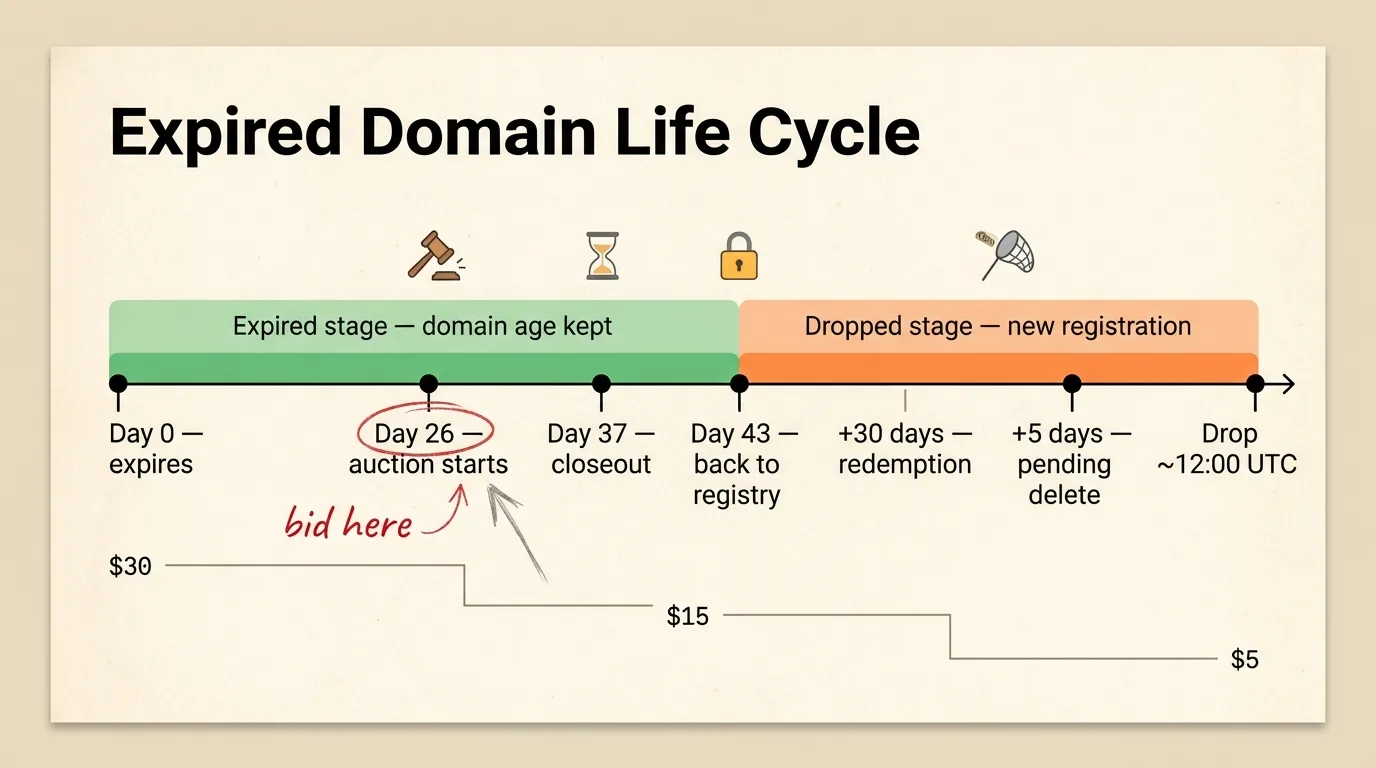
Two things in this timeline matter more for SEO than any metric:
- Domain age survives only at the expired stage. When you buy an expired domain name at this point, the old registration is transferred to you, so the creation date stays. A dropped domain is a new domain registration: WHOIS shows a fresh date. The backlinks are still there, but the "aged" label is gone.
- You can predict where a name will go. Check the "Registrar" field in RDAP (the lookup that replaced WHOIS at ICANN in January 2025) a month or two before the name runs out. Enom, Tucows, Name.com, Hostinger, Squarespace and Wix send their names to the largest platform in the table. Network Solutions, Register.com, Bluehost and HostGator send them to the Newfold pair (the next two rows). Dynadot sells its own. Anything unsold drops and goes to the catchers.
Many old guides still map Enom and Name.com to the Newfold pair. That's outdated: in 2026 both send their names to the largest platform. Use the wrong map, and you'll watch the wrong site and miss the name.
Under ICANN rules, a company can refuse a transfer for 60 days after a new registration, and a 60-day lock usually follows a change of owner. A caught name will sit at the catcher's company for about two months. Set up DNS and hosting there, and don't count on moving it to your usual domain registrar right away.
Expired Domain Auctions: 8 Platforms Reviewed
GoDaddy Auctions
The largest single pool. Its own brands and a long list of partner companies send their names here: Domain Name Wire counted 29 sources in March 2026. On any given day there are hundreds of thousands of live listings.
How it works. Names go up for a 10-day auction 26–29 days after expiry. The starting bid has been $25 since October 2023 (it used to be $12), and the renewal fee is added on top of the final price. Membership costs $4.99 a year. You have 48 hours to pay, then the card on file is charged. If that fails, you lose the domain and your membership is suspended. The name usually lands in your account within 15 days.
Closeouts. Names nobody wanted go to a final closeout, where the price drops every day, down to $5 plus renewal. This is where I pick up plain, boring names with a clean backlink profile that nobody noticed.
What changed recently:
- Backorders were discontinued in October 2025. You can't reserve a name in advance here anymore.
- The platform's API opened to all members in August 2026. Expect more bots on closeouts: cheap finds now disappear faster.
- From October 1, 2026, the .co registry banned company-run sales of expired .co names without its approval. Don't expect many .co names here anymore.
Pros: the biggest volume, 10 days to see the real price, and domain age is kept because there's no drop. Cons: a $25 start plus renewal makes junk expensive. During the first days, the old owner can still renew and "pull back" the name, even while you're leading.
The owner can renew until about day 29, even if someone has already made an offer. Early bids only show your interest and push the price up. Watch the name and place your bid after day 30, when it can no longer be pulled back.
When we pulled the full public inventory in autumn 2026, nobody had made a single offer on over 99% of roughly 700,000 listings. Real competition sits on a few thousand names. Don't scroll the catalog; filter by backlinks, age and history first.
NameJet
Owned by Newfold Digital. It gets names from Network Solutions (Web.com merged into it in June 2025), Register.com, Domain.com, Bluehost, HostGator, Dotster, Crazy Domains and several others. These are old companies, so the pool is full of names from the late 1990s and 2000s with real history.
How it works. You place a backorder (a free request to buy the name if it becomes available) and pay only if you win. If you're the only one, you get the name at the minimum price, about $69–79, with a year of registration included. If two or more people ordered it, a 3-day closed auction starts, and only they can take part.
Prices are going up. Casino and iGaming buyers now hunt high-value domains in this pool. Of 44 names with DR 15+ sold in this pool in August 2026, at least 13 became casino sites or redirects, at prices from $3,986 to $16,500.
Pros: strong old names and a small closed circle of buyers. Cons: a high minimum, few public rules, and casino money on anything with a decent domain rating.
The sale is closed. If you didn't order before the deadline, you're out. Add orders at least a day early: a name nobody else ordered goes to you at the minimum price.
SnapNames
The sister site: same owner, shared inventory, same mechanics. In its public deleting list, every name starts at $79.
For me its real bonus is that list. It's a free daily domains list of about half a million names in .com, .net, .org, .info, .biz, .us, .cc, .tv and .co.uk that are about to be deleted. Download it, filter by length, words and zone in a spreadsheet, and you've got a free drop list for the first pass.
Pros: the same strong pool, and the list. Cons: a dated interface and a $79 entry.
DropCatch
The main venue of the dropped stage. It uses a huge network of accredited companies, so its systems can register a domain in the first moments after deletion. It's a favorite of the domain investing crowd.
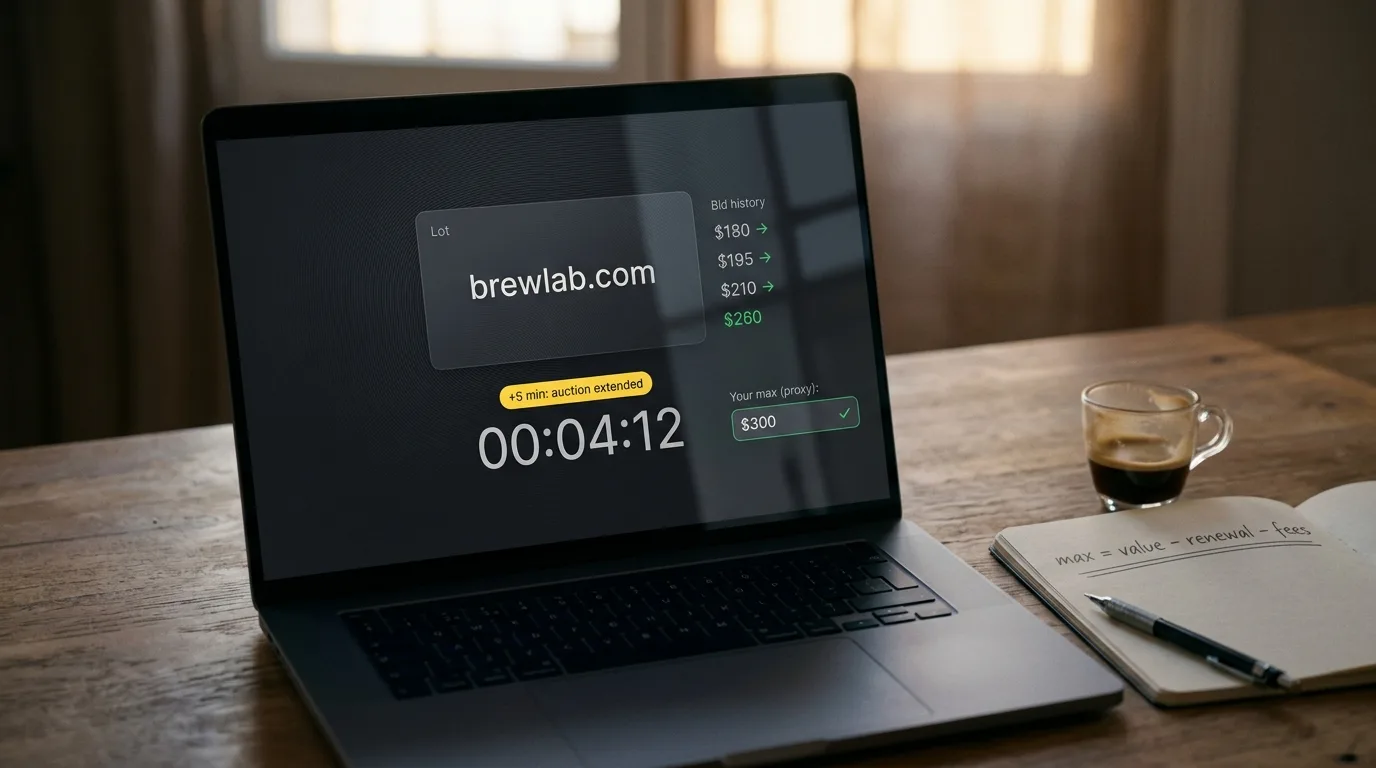
How it works. Orders are free, and you're charged only after a successful catch. If you were the only one, you pay the fixed price for the zone (about $59 for a .com), which includes the first year. With two or more orders, the name goes to a public auction for 3–5 days. It ends at 1 p.m. Mountain Time, on weekdays only (no weekend endings since April 2025). A bid in the last 5 minutes resets the clock to 5 minutes. Every offer works as a proxy (an automatic maximum): the winner pays the second-highest price plus one step.
Extra costs: photo ID verification (up to 72 hours) and a 3% fee if you top up by card or PayPal. Caught names are managed at NameBright. For .com and .net, orders must be in by 11:30 UTC since the drop time moved.
Pros: the strongest catching power and clear rules. Cons: the competition is public, so domain investors who make a living buying and selling domains push up prices on the best dropped domains.
A name that went unsold at the expired stage isn't junk by default. Often nobody simply noticed it. Orders are free here, so add everything on your shortlist: you pay only for what's caught.
Dynadot
Sells its customers' names once they expire, and also catches dropped ones.
How it works. Its expired auctions last 7 days, and a late bid in the last 5 minutes adds 5 more. In most cases the price includes a year of registration. Bids over $2,000 need a 5% deposit, which you lose if you don't pay. Closeouts go $30 → $15 → $5 over three days, plus renewal. Catch orders are free to place and cost $24.99 for .com, .net, .org, .info and .xyz if the catch succeeds (.io costs $124.99). If several people order the same name, it goes to an open auction for 7–10 days.
Pros: the cheapest catches, renewal usually included, and less attention than at the biggest platform, so bargains do happen. Cons: a smaller pool.
Namecheap
Sells its own expired names, plus listings marked "Partner".
How it works. Bidding requires a $5/year subscription. A late bid extends the auction by 5 minutes. You pay within 72 hours, or the name is relisted. Most names start at $15 plus renewal, some at $5 or $10. Some .ai and .io names start at $400 and fall step by step, adding 24 hours each time, down to $10 if nobody steps in. Its Market section is separate: owners' fixed-price listings with a 10% seller commission.
Pros: cheap entry and a good source of .ai and .io. Cons: start prices are inconsistent, and partner names come from other sellers.
In .ai and .io price drops, most people wait for the bottom. On a name you really want, buy one step earlier than the crowd: the saving from waiting is smaller than the risk of losing it.
Sedo
The largest European venue. Its expiring auctions start at $79, run 7 days and get 2,000+ new names a day. But most of the catalog is a domain marketplace: owners' domains for sale at a fixed price or by offer. It's a good place to find domains for sale in country zones.
Fees. Buyers pay no commission on marketplace sales, and the transfer is free. Sellers pay 10–20%.
Pros: many international names and a safe transfer process. Cons: a $79 entry for expiring names, and many owner prices sit far above real value.
Afternic
Not a place for expired names at all. Every domain for sale here is listed by its owner and shown on 100+ partner sites where people buy domains, with automatic "Fast Transfer". Buy Now prices are binding; the minimum offer is 65% of the Buy Now price. Sellers pay 15–25% commission. It belongs to the same group as the largest platform in this list.
When to use it: when you need to find the perfect domain name for a brand, or one specific domain that isn't coming up for sale anywhere else. For SEO it rarely pays off: most names here were registered by hand and never had a site or backlinks.
How to Find Expired Domains on All Platforms at Once
Checking eight sites one by one doesn't scale. To find a domain fast, most people use aggregators:
- ExpiredDomains.net: free, 700+ zones, advanced search by backlinks, age and words, but no spam check.
- SpamZilla: spam score, drop history and redirects; paid.
- DomCop: metrics from several tools in one table; paid.
If you'd rather buy expired domains from one catalog, deepscan.pro collects lots from dozens of auction platforms and runs a free domain history check with a spam verdict on each name, before you bid.
How to Check an Expired Domain Before Buying
A valuable domain for SEO is the one with a clean past, not the one with the highest DR. Here is the check I run before buying a domain, cheapest steps first.
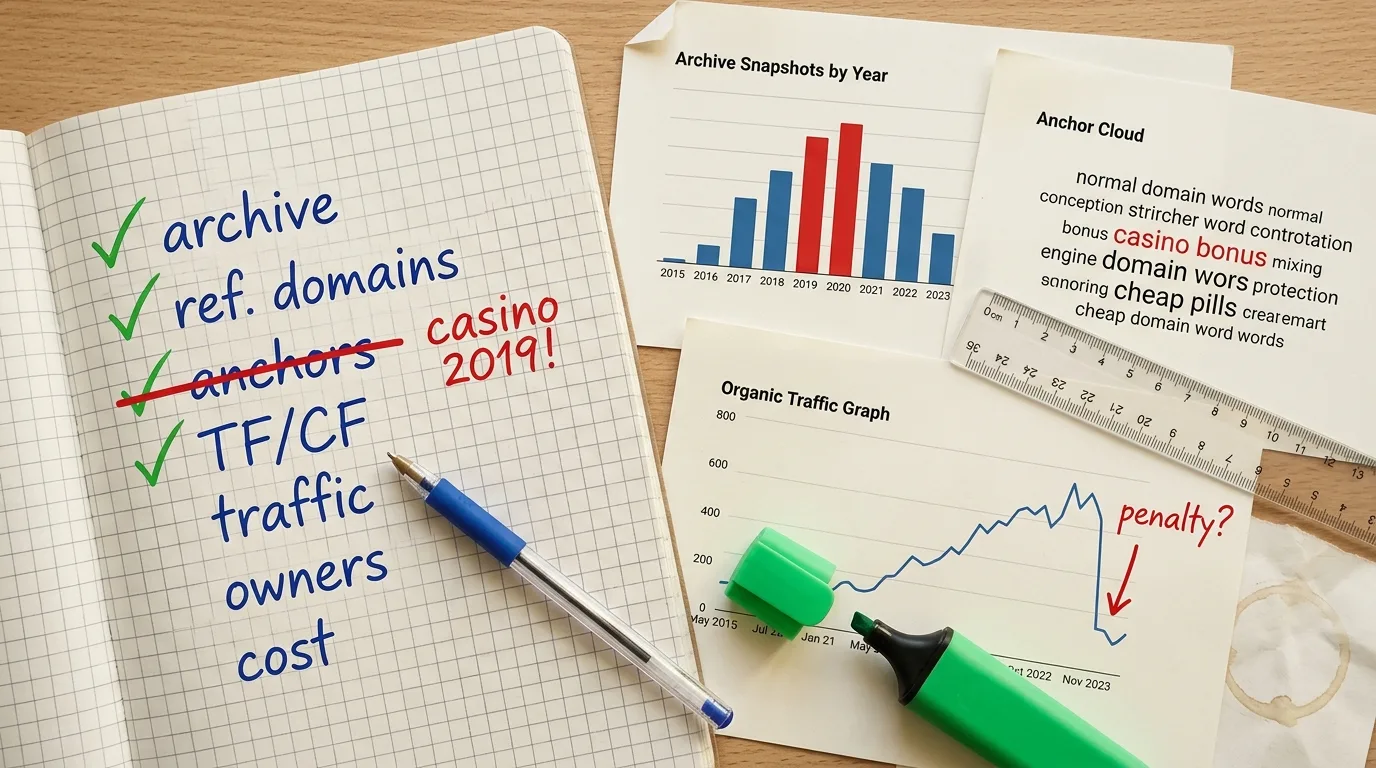
- Archive history. Open the Wayback Machine and go year by year. Red flags: Chinese or Japanese text on an English site, casino, pharma or adult pages, a sudden topic change, years of parking, redirects to unrelated sites. One spam period is enough to reject a name for a money site.
- Backlink history. Look at the number of referring domains (unique sites that link to it), not only DR or domain authority. A high domain authority score with 10–20 referring domains means a couple of strong links or a link farm. Check anchors: casino, pharma, loans or foreign-language anchors mean "no". If more than about 40% of anchors are exact commercial phrases, the profile was built, not earned.
- Trust vs volume. In Majestic, Trust Flow (link quality) much lower than Citation Flow (link volume) usually points to spammy links.
- Traffic. Domains with traffic are rare and worth paying for, because existing traffic proves Google still trusts the name. A sharp crash in organic traffic on one date can mean the site was penalized by search engines, and that penalty can stay with the name.
- Owners and drops. Three or more owner changes a year, or several drops in a row, mean the name has been flipped around as a PBN.
- Trademarks and blacklists. Brand names bring legal risk. Run the domain through Google Safe Browsing and spam blacklists.
- Total cost. Price + renewal + membership + transfer. Some zones charge premium renewal every year.
Backlinks carry over to the new owner; old rankings and traffic don't. Even a great domain needs content on the same topic before it starts working again.
How to Bid Without Overpaying
- Set a proxy maximum and walk away. Value minus renewal, fees and transfer equals your ceiling. Sniping rarely works: most platforms add 5 minutes after a late bid, so the auction process turns into a duel. Never raise "just one more step".
- Go in late where the owner can pull back. At the biggest platform, wait until day 30.
- Search in cycles. Closeouts and pending delete each last about 5 days, so a search every 5 days catches almost everything. Daily searches catch more of the quality expired names before others do.
- Don't trust results from other sites blindly. In September 2026 one name sold for $5,805 in a closed auction, then "sold" for $12,166 in a public auction, and that payment was still pending. Check real domain sales on NameBio before you anchor on a number.
- Use the closeout stage. Many domain auctions offer a fixed-price stage after the main round. If nobody stepped in, the price only goes down, though the best expired domains rarely get that far.
What to Do After You Buy: White, Grey and Black
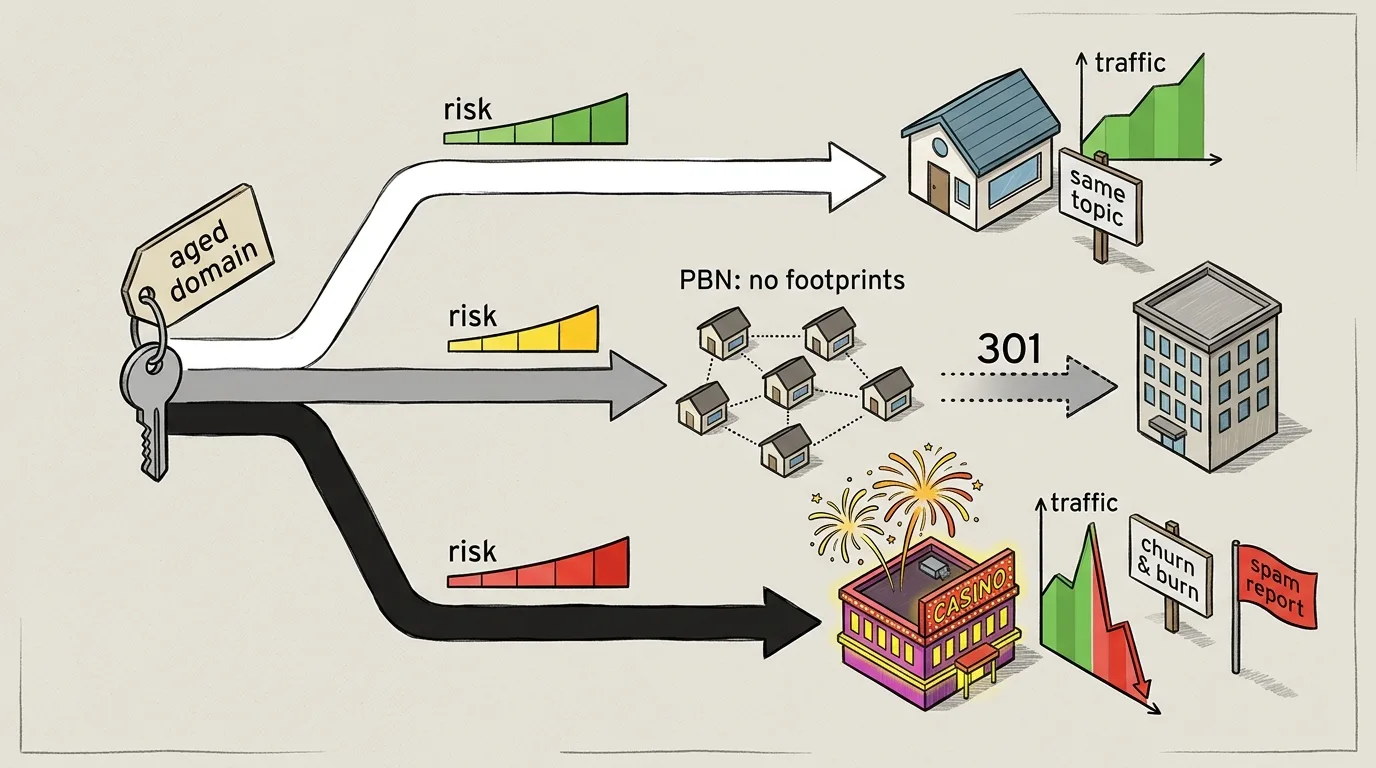
The platform doesn't care what you build. Google does. Purchasing expired domains for SEO only makes sense when you know which path you're on.
- White. A new site on the same topic. Restore the pages with the most links using fresh, better content, and 301-redirect other old URLs to the closest new page. Google itself says reusing an old domain for an original site is fine.
- Grey. A 301 redirect to a money site, or a PBN. Redirect page to page, not everything to the homepage: Google can treat mass redirects to one page as a soft 404 and ignore the links. For a PBN, keep the old topic, rebuild from the archive, and use separate hosting, themes and plugins, so the sites share no footprints.
- Black. Churn-and-burn: casino or affiliate pages on an old trusted name. In one analysed case, a casino page on an expired restaurant domain hit about 590,000 visits at its peak and fell to about 1,300 within weeks. Some iGaming teams work on subdomains, so they can cut off a burned one and keep the rest.
Since March 2024, Google's spam policy names "expired domain abuse": buying an expired domain mainly to manipulate search engine rankings with low-value content. Since May 2024, anyone, your competitors included, can report it through a spam form. Keep money sites off that path.
Which Auction Site to Choose
- PBN on a budget: closeouts at Dynadot and at the biggest platform, plus DropCatch for dropped names.
- Strong old names with history: the Newfold pair, and the 10-day sales at the biggest platform.
- A brand or a premium domain: Afternic and Sedo.
- .ai and .io: the price-drop sales described above, plus Dynadot.
- European and other country zones: Sedo.
There's no single ideal domain source. The right domain is one that passes the history and backlink check at a price you'd pay again, so look for domains with clean histories first and judge metrics second. Quality domains turn up on every one of these platforms; the edge comes from checking faster and staying calmer than the crowd. That's how you buy expired domain names that keep working for years, not weeks.
Comments
Sign in to leave a comment
No comments yet — be the first.